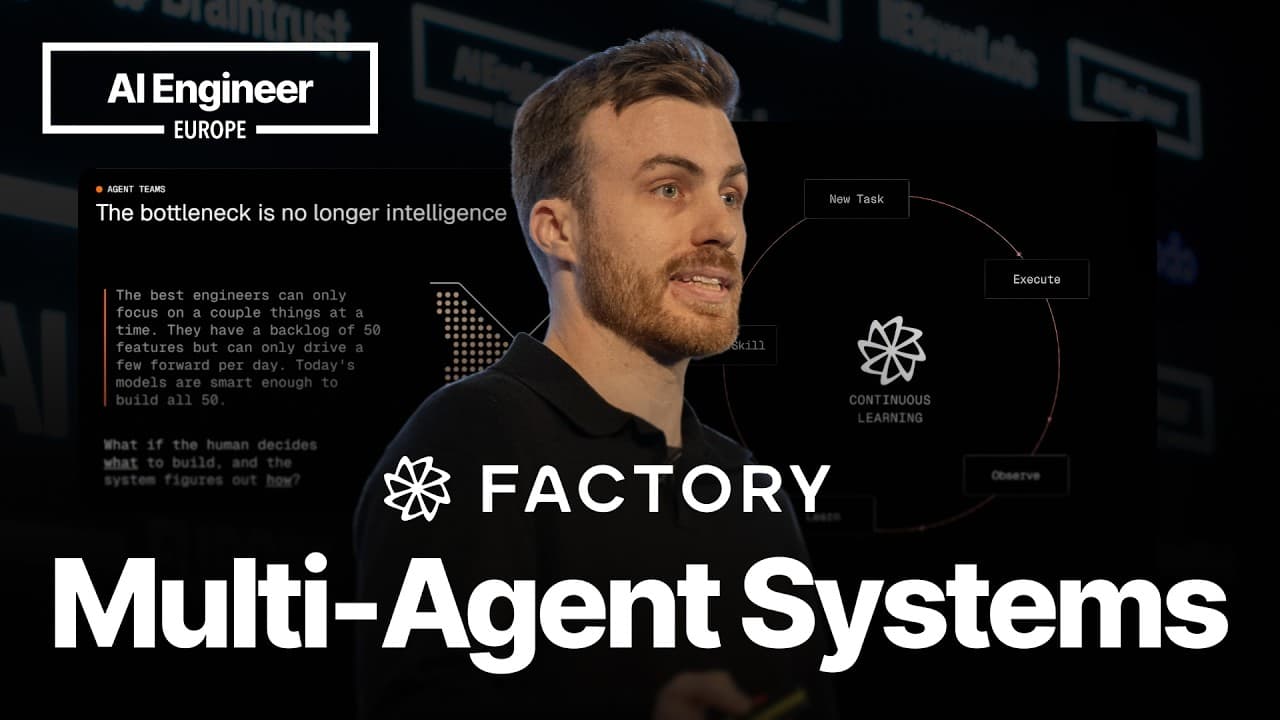
Harness Engineering: How to Build Software When Humans Steer, Agents Execute — Ryan Lopopolo, OpenAI
Summary
Ryan Lopopolo, Member of Technical Staff at OpenAI, delivered a keynote and extended Q&A at AI Engineer Europe 2026 on "Harness Engineering" — a philosophy and operational framework for building software when humans steer high-level strategy while coding agents execute implementation. Lopopolo opened by declaring himself a "token billionaire," spending over one billion output tokens per day (exceeding $1,000/day), and described banning his team from touching their editors directly, requiring all implementation to flow through coding agents.
The central thesis is that implementation is no longer the scarce resource in software engineering. Lopopolo argued that GPT-5.2 (released in late 2025) was the inflection point at which models became "isomorphic" to human engineers in code quality, making code effectively free to produce, refactor, and delete. The true scarce resources are now human time, human and model attention, and context window. Each engineer today has access to the equivalent of 5, 50, or 5,000 engineers working 24/7, limited only by GPU capacity and token budgets.
Lopopolo's team operates with 3–5 PRs per engineer per day. To manage this velocity, they instituted "Garbage Collection Fridays" — one day per week dedicated to categorically eliminating any class of slop observed during the week by converting review feedback into documentation, lint rules, and automated reviewer agents. This transforms synchronous human review time into durable, auto-enforced guardrails.
A key architectural principle is structuring the repository for agent legibility: their monorepo has grown to 750 packages in a PNPM workspace, organized by business logic domain and stack layer, with strict package privacy enforcing dependency edges. Files are kept under 350 lines (enforced by a test). Canonical implementations of async helpers, Zod schemas, and concurrency utilities are lint-enforced to prevent agents from re-implementing shared utilities locally. The rule is: one programming language, one ORM, one way to write CI scripts, one way to add lint rules — because uniform code makes model-produced tokens more predictable.
Harness engineering is defined as surfacing the right instructions to the model at the right time — not frontloading everything, but using just-in-time prompt injection via failing tests, lint errors with actionable remediation steps, and reviewer agents triggered on every push. Lopopolo's team maintains 5–10 skills (not hundreds) that abstract away rapidly-changing local dev tooling so humans don't need to track infrastructure churn. Skills teach Codex how to launch the app, spin up a local observability stack, and attach Chrome DevTools via a daemon — enabling the agent to own the full development loop.
On code review, persona-based reviewer agents (front-end architect, reliability engineer, scalability engineer) are triggered on every push, using persona documentation to surface P2+ blocking issues autonomously. The goal is removing humans from synchronous review loops entirely. Lopopolo noted that every time a human must type "continue" to an agent is a harness failure — the harness should provide enough context for the agent to reach completion on its own.
Lopopolo framed code as a "disposable build artifact" and LLMs as "fuzzy compilers" — analogizing harness constraints to LLVM optimization passes that limit which machine code is acceptable to emit. Swapping models is like changing a code generation backend: the constraints (non-functional requirements, lint rules, review agents) should produce acceptable output regardless of which model runs.
Looking forward, Lopopolo described his target state: providing a token budget and a quarter-to-year's roadmap, letting machines continuously advance the product without human hands on the wheel, while human attention shifts to triage, user feedback, runbooks, PII audits, and other squishy operational concerns.
Key Takeaways
- •Every time you must type 'continue' to an agent is a harness failure — the harness should supply enough context for the agent to complete the task autonomously.
- •Implementation is no longer the scarce resource; the scarce resources are human time, human/model attention, and context window. Organize work accordingly.
- •Run 'Garbage Collection' sessions (e.g., weekly Fridays) to convert recurring review feedback into permanent lint rules and reviewer agents, eliminating slop categories durably.
- •Keep files under 350 lines and enforce it with a test — this is context engineering that directly improves agent performance without touching model weights.
- •Centralize leverage in 5–10 well-maintained skills rather than going wide, so humans don't need to track rapidly-changing infrastructure internals.
- •Use persona-based reviewer agents (reliability, front-end, scalability) triggered on every CI push to replace synchronous human code review at scale.
- •Structure your monorepo with strict package privacy and canonical shared utilities, then lint-enforce their use — agents tend to optimize for local package coherence rather than reusing shared helpers.
- •Write non-functional requirements documentation (security, retry/timeout patterns, QA plan templates) once; every agent trajectory then inherits the best judgment of your whole team.
- •Provide lint and test failures with concrete remediation steps — 'you have an unknown here because we parse-don't-validate at the edge' is far more useful than a bare type error.
- •Prefer first-party harnesses (Codex, Claude Code) because the labs post-train models in the context of those specific harnesses, giving you leverage from their training process.
Transcript
Our [music] next speaker is here to speak about harness engineering. How to build software when humans steer and agents [music] execute. Please join me in welcoming to the stage member of technical staff at OpenAI, Ryan Leopo. [applause] [cheering] Good morning, London. [applause] I'm super excited to be here today. I'm Ryan Laapo and for the last nine months I have had the privilege of building software exclusively with agents. Uh I am a token billionaire and I believe that in order for us to g...
Speakers
Topics
Related Sessions