Google Cloud Next ‘26 Keynote: Building the Agentic Enterprise (Every Major Announcement)
Summary
The Google Cloud Next '26 Opening Keynote, led by Thomas Kurian and other Google Cloud leaders, declared the end of AI experimentation and the arrival of enterprise transformation. Kurian opened by noting that nearly 75% of Google Cloud customers now leverage AI products in production, signaling a shift from pilot projects to full-scale deployment.
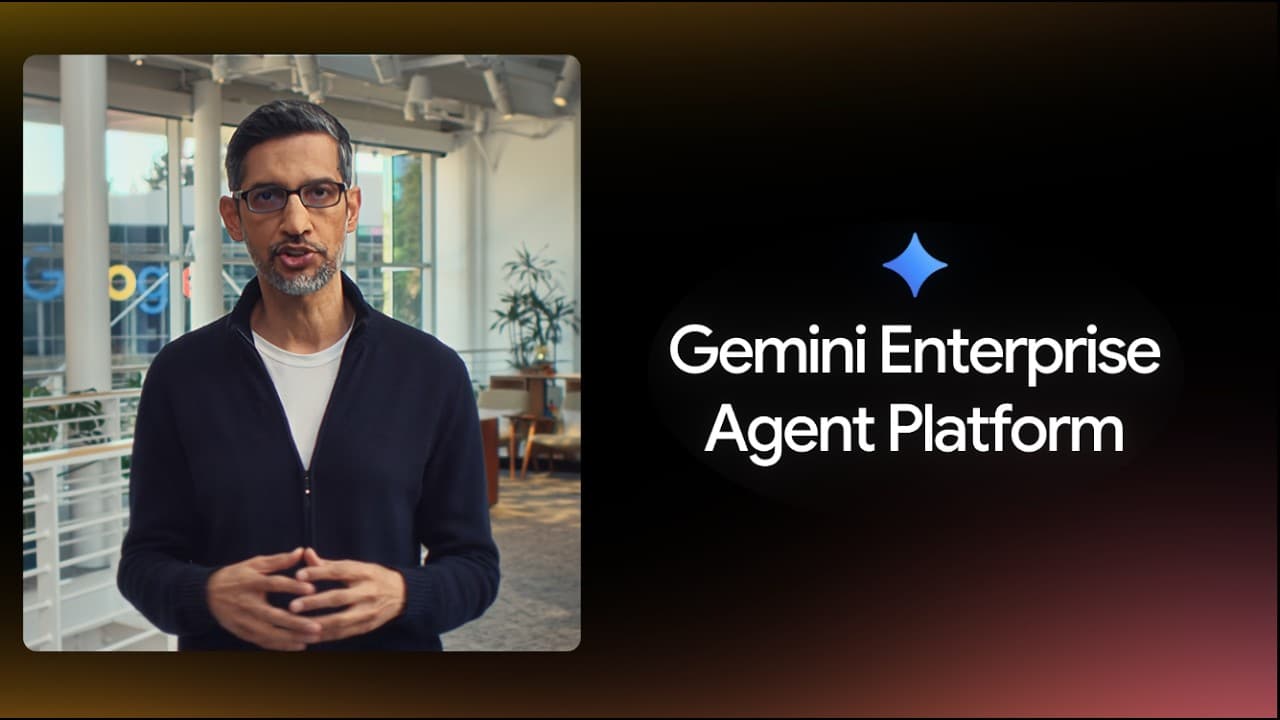
The centerpiece announcement was the Gemini Enterprise Agent Platform, described as 'mission control for the agentic enterprise.' The platform provides a unified stack for building, scaling, governing, and optimizing agents. Key components include a low-code Agent Studio for natural language-based agent creation, an Agent Registry for centralized control across an organization, a Skills and Tools Registry for reusable modular agent capabilities, an Agent Marketplace for deploying third-party specialized agents, and Agent Identity — a system that assigns each agent a unique cryptographic ID with auditable authorization policies. Google also introduced Gemini Enterprise Projects, giving agents a persistent high-fidelity workspace with 'deep think' capabilities and Microsoft 365 interoperability for exporting documents to Office formats.
On the infrastructure side, Google announced its eighth-generation TPUs with two specialized platforms: TPU8 for training (featuring two petabytes of shared bandwidth memory, enough to hold the Library of Congress 100 times over) and a second variant optimized for inference and reinforcement learning. The Google Cloud Axion processor was highlighted for general-purpose workloads. Citadel Securities was cited as a customer using this infrastructure to compress multi-week workloads into hours.
The Agentic Data Cloud was introduced as a rethinking of the data platform, featuring four innovations: a Knowledge Catalog acting as a universal context engine that instantly tags and enriches files upon upload with zero manual engineering; a Gemini-powered Data Agent Kit for data science workflows; a Lightning Engine for Apache Spark delivering up to 2x price-performance over the previous market leader; and a Cross-Cloud Lakehouse built on the open Apache Iceberg standard, enabling analytics across clouds without data movement or vendor lock-in.
On security, Google unveiled a Gemini-native Agentic Security Operations Center (SOC) and officially welcomed the Wiz team to Google Cloud, introducing the first AI Application Protection Platform. The platform autonomously identifies, investigates, and remediates risks using a security graph.
Customer stories included NASA using Gemini Enterprise Agents for flight readiness and astronaut safety on the Artemis 2 mission, The Home Depot deploying Magic Apron for in-store and online customer assistance, Virgin Voyages using Gemini Enterprise for crew Q&A confidence, and Unilever leveraging the platform for enterprise transformation. Google also announced that migrating from Microsoft 365 to Google Workspace is now up to five times faster.
Key Takeaways
- •75% of Google Cloud customers have moved AI from pilot to production — the experimentation era is declared over.
- •The Gemini Enterprise Agent Platform provides end-to-end lifecycle management for agents, including identity, governance, and a marketplace of partner agents.
- •Every agent now gets a unique cryptographic ID with auditable authorization policies, addressing enterprise concerns about shadow AI and accountability.
- •8th Gen TPUs include two specialized platforms — one for training (2 petabytes shared bandwidth memory) and one for inference and reinforcement learning.
- •The new Knowledge Catalog eliminates manual data engineering by instantly tagging and enriching files the moment they land in Google Cloud Storage.
- •The Cross-Cloud Lakehouse built on Apache Iceberg allows analytics across any cloud without moving data, removing vendor lock-in.
- •Lightning Engine for Apache Spark delivers up to 2x price-performance improvement over the previous market leader.
- •Wiz integration brings an autonomous AI security layer that identifies and fixes critical risks at machine speed using a security graph.
- •Migrating an entire organization from Microsoft 365 to Google Workspace is now up to 5x faster with new migration and interoperability tooling.
Transcript
Hello, welcome everyone to Google Cloud Next. Just one year ago, we stood on this same stage and promised a new future for AI. Over the last year, we didn't just see adoption, we saw transformation. Nearly 75% of Google Cloud customers now leverage our AI products to power their businesses. You have moved beyond the pilot. The experimented phase is behind us. The answer is a unified stack. You cannot deliver AI by piecing together a puzzle piece of fragmented silicon and disconnected models. To ...