[Google Masterclass] Beyond the Search Bar: Winning in the AI Travel Era
Summary
Wishy Arora, Ecosystem Product Management Lead for Travel at Google, delivered a 40-minute masterclass at ITB Berlin 2026 on how Google's AI products are fundamentally reshaping travel search — and what travel companies must do to remain visible in this new landscape.
Arora opened by framing the core shift: the old 'unwritten contract' between search engines and users — where users decomposed complex travel intentions into 3-5 word queries and did the synthesis work themselves — is now obsolete. Today, users are submitting queries 2-3x longer than they were even a few years ago, providing full context ('I want to go somewhere this weekend with friends, we're big foodies, want something off the beaten path') and expecting AI to 'do the magic' in return. This shift is not aspirational; it is live in Google's production systems today via AI Mode.
Arora explained Google's technical stack that makes this possible: it is not just LLMs (Gemini) alone, but LLMs grounded in five distinct data layers — the Knowledge Graph (billions of real-world facts), rich web content (text, video, reviews, audio, photos), live price and availability feeds from travel partners, geographic/maps data, and personalized user context (opt-in). He stressed repeatedly that an LLM without grounding is insufficient, and that the differentiated value comes from stitching all these layers together.
He demonstrated this with four live examples, all of which he said are in production and testable today: (1) AI Flight Deals — now live in 200+ countries — where users can search 'I want sun and sandy beaches in May for a long weekend' and receive dynamic pricing insights, e.g., Palma flights at a 32% discount in May vs. typical prices. (2) Hotel search for 'family-friendly hotel in the Dolomites near hiking trails with a heated pool' — AI Mode can cross-reference maps data for proximity to trails, metadata for heated indoor pools, and user reviews to surface that a specific hotel has 'comprehensive childcare for kids of all ages' or 'private bridge access to the Cisles Arm cable car for hiking.' (3) Multi-city Europe rail and budget trip planning for a student — AI not only generates an itinerary but adds contextual value like flagging the Bernina Express between Switzerland and Italy as a must-not-miss highlight. (4) Multi-day Ireland driving itinerary — AI can surface live music start times (typically 6 PM and 9:30 PM in Toghcloillie) extracted from buried restaurant websites and user reviews, not from structured feeds.
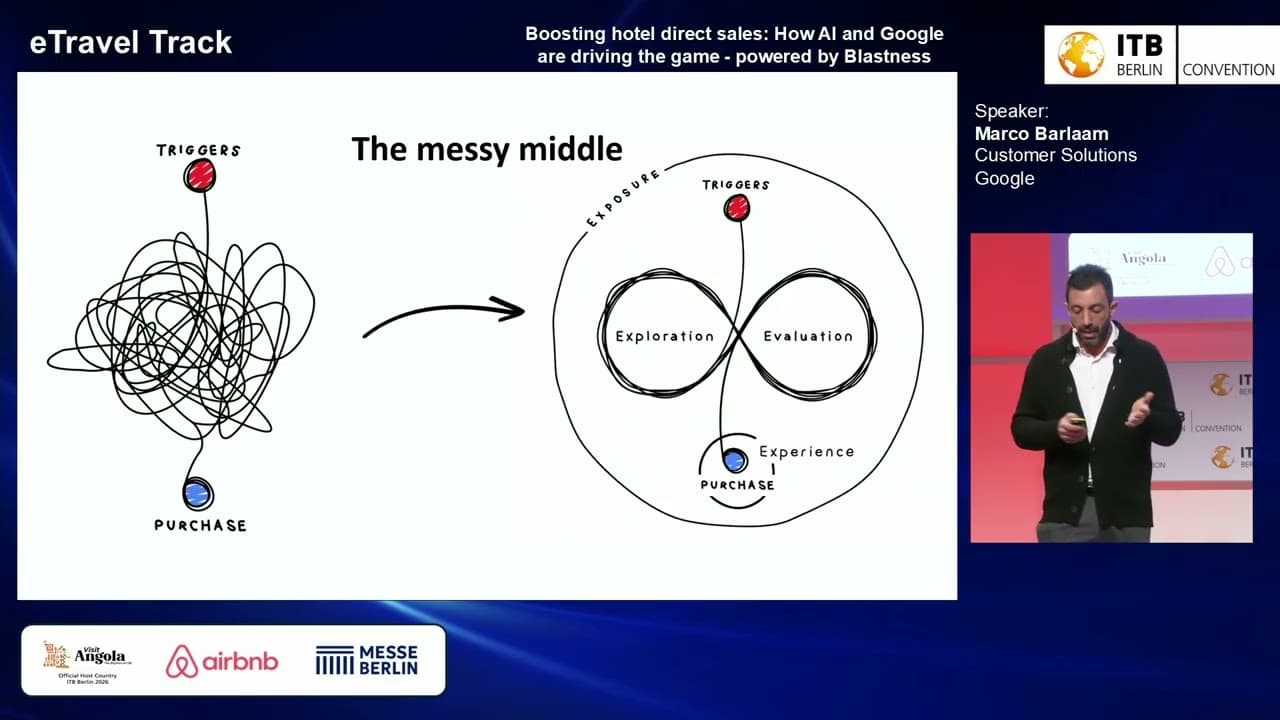
On in-session booking: Arora announced that in November 2025, Google launched a test of direct in-AI-Mode hotel booking in partnership with an array of travel partners. Users can search, filter room types, compare rates, and complete a booking confirmation without leaving AI Mode — while the partner remains the merchant of record and handles post-booking support. This convergence of planning and transaction is what Arora calls the disappearance of the 'messy middle.'
For travel companies preparing for this era, Arora laid out a four-layer readiness roadmap: (1) Web content and SEO — SEO remains the foundational layer for LLM content sourcing; structured data markup per schema.org (hotels, locations, restaurants, attractions) is critical; 'people-first content' with authentic human voices and factual grounding matters more than ever. (2) Feeds — live price and availability feeds from partners remain more powerful than MCP/API protocols for broad flexible queries; MCP can answer a specific origin-destination-date query, but answering 'anywhere with sun and sand across 30 days' requires running millions of market-date pair combinations only feed caches can handle. (3) Personalization via identity and loyalty — OAuth-based account linking lets Google identify loyalty status, tailor rates, and streamline AI Mode checkout; Google Wallet integration helps AI surface loyalty-specific rates; partners can already share targeted rates for loyalty members and should do so. (4) Agentic readiness — invest in modern, low-friction payment stacks with observability (how many users attempt payment, failure rates, failure reasons); maintain performant, standards-based APIs for availability, pricing, and booking; Google is developing multiple integration paths including direct API integrations and browser-based agentic bookings, with more to be announced.
Arora closed with a memorable anecdote: for his wife's birthday (March 2, 2026 in Zurich), he asked AI Mode 'where can I get good tres leches cake in Zurich?' — it surfaced La Takaria prominently. When he asked what SEO or data changes La Takaria had made to achieve this visibility, the answer was zero. The restaurant simply focuses on great food and experience, which generates authentic reviews — and that organic social proof is what surfaces them in AI. His final advice: do everything in the technical roadmap, but ultimately the best strategy is to deliver experiences customers actually rave about.
Key Takeaways
- •User queries in Google AI Mode and Gemini are now 2-3x longer on average than traditional search queries. Users are giving full context ('I want to go somewhere this weekend with friends, we're big foodies, off the beaten path') and expecting AI to synthesize and deliver solutions — the old model of users decomposing their intent into simple queries is over.
- •Google AI Flight Deals is now live in 200+ countries, enabling flexible-date and flexible-destination queries. Arora demonstrated a live example showing Palma flights at a 32% discount in May compared to typical prices — surfaced by matching natural language queries to live feed pricing data.
- •Google announced in November 2025 that users can now complete hotel bookings (room selection, rate comparison, booking confirmation) entirely within AI Mode without leaving the Google interface. Partners remain the merchant of record and handle post-booking support, but the planning-to-booking funnel is now fully inside Google's AI experience.
- •Live price and availability feeds from travel partners are more powerful than MCP/API protocols for broad flexible queries. A specific origin-destination-date query can be answered via MCP, but a query like 'anywhere with sun and sand over 30 days' requires running millions of market-date pair combinations — only feed caches built over years of partnerships can handle this scale.
- •Google's AI answers are grounded in five distinct layers beyond the LLM itself: (1) Knowledge Graph with billions of real-world facts, (2) rich web content including video, reviews, audio, and photos, (3) live price and availability feeds from travel partners, (4) geographic/maps data, and (5) opt-in personalized user context. An LLM alone is insufficient — grounding is what makes responses 'magical.'
- •SEO remains the foundational content source for LLM-powered Google products. Arora explicitly stated 'SEO remains very important' and that Google continues to source the majority of content from the open web. Travel companies should continue SEO best practices as the baseline for AI visibility.
- •Structured data markup per schema.org — covering hotels, locations, restaurants, and travel attractions with rich attributes — directly helps LLMs extract and surface specific value propositions (e.g., 'heated indoor pool,' 'comprehensive childcare,' 'private cable car access'). These attributes are what distinguish a hotel in an AI-generated response.
Transcript
All right. All right. All right. You know what I love? People always tell me at ITB that the last day is not worth it because everyone's left. You know, it's the third day, so you shouldn't plan anything on that day. And thank you to everyone here in the room for proving them wrong because I think that's not right. And everyone at home joining us via the live stream, thank you for tuning in, joining us for the third day of the ITB Berlin Convention 2026. Are you ready to maximize the third day o...