Hotels as Neighbourhood Hubs and Third Places | Industry Leaders Inspiration
Summary
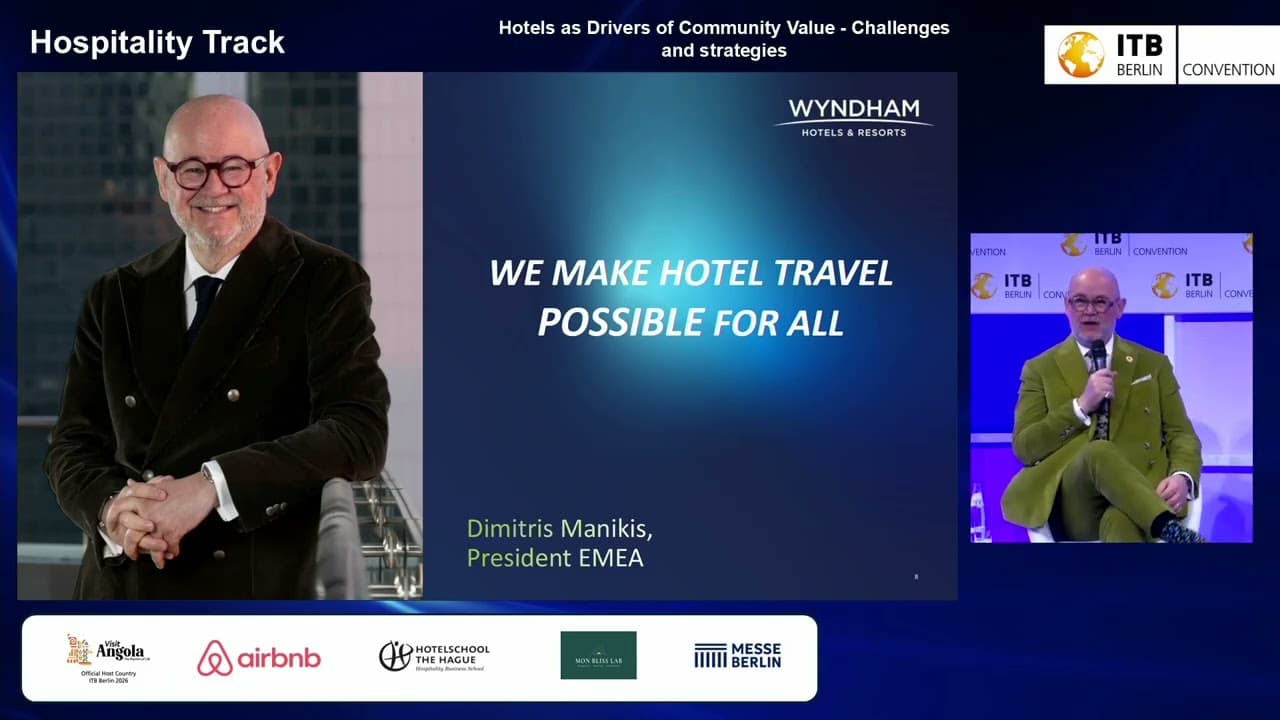
This fireside chat at ITB Berlin 2026, moderated by Jan Huizing (researcher at Hotelschool The Hague), brought together Dr. Ingo Burmester (CEO Hotel Division, DERTOUR Group) and Dr. Renée Nicole Wagner (Corporate Director ESG & Quality Management, Orascom Hotels Management) to explore how hotels can function as neighbourhood hubs and 'third places' for local communities.
DERTOUR Group, now exceeding 10 billion euros in annual revenue, operates across the full tourism value chain including DMCs and hotels. Orascom Hotels Management, an Egyptian operator based in Zurich, runs 34 hotels across Montenegro, Switzerland, Oman, and Egypt. Both companies are grappling with how to embed themselves meaningfully into local communities at their destinations.
Renée Wagner defined community expansively — not just geographic neighbors but the entire business ecosystem: front-of-house staff, back-office teams, and crucially, suppliers. She resists distinguishing between community types by destination geography (mountain vs. beach), arguing the relational fundamentals remain the same. Her approach to ESG's social dimension involves building mandatory 'social days' into the annual hotel strategy roadmap across all 34 properties, using existing passionate team members as internal champions to bring others along.
A standout human case study: an Egyptian GM at their El Gouna (Aluna) property who retired but was brought back at 50% capacity to serve as a local ESG champion — preserving institutional and cultural knowledge while keeping an engaged team member active. Wagner described this as her 'local hero' model.
Ingo Burmester drew a sharp distinction between two types of destination development: entering an existing ecosystem where infrastructure is already in place versus pioneering a 'virgin' destination like the Maldives, Morocco in its early days, or Cabo Verde. In the latter scenario, the hotel group must work closely with local communities to understand the existing ecological and cultural ecosystem before developing. He cited specific sustainability challenges: freshwater supply via reverse osmosis, solar photovoltaic and photothermal energy systems as alternatives to CO2-heavy power infrastructure. His core argument: ecological best practice and economic best practice frequently align — sustainability is not a cost centre.
DERTOUR's Henry Hotels brand in Hamburg was highlighted as a concrete third-place example: a ground-floor living room and kitchen concept in a tower property that invites local residents and external visitors to use workspace, eat affordably, and interact with hotel guests. Burmester uses it regularly as a personal workspace. The brand is planned for expansion.
A striking community integration case from the Canary Islands: DERTOUR's Plitas (in Fantura village) sports hotel opened its entire sports infrastructure — padel courts, golf course, and other facilities — to the public for free. They also run an on-property grocery store priced slightly below the village shop, which now supplies 70% of the local Plitas village's grocery needs, turning the hotel into a genuine community anchor. The property also builds staff housing in response to the Canary Islands over-tourism crisis driving apartment costs beyond staff affordability.
The conversation identified two structural dilemmas that Burmester explicitly asked researchers to investigate: (1) The income gap between source markets and destination labor markets — HR costs in Egypt are below 20% of total costs vs. over 45% in Switzerland, creating a fundamental tension between affordable luxury offerings and genuine community economic integration; (2) The cultural distance problem — when cultural differences are large, intentional bridging formats and actions are needed, not just information sharing. Burmester also flagged supply chain localization as a challenge: standardized quality requirements from existing fixed suppliers make it hard to onboard local suppliers who may not meet brand standards.
Wagner's closing challenge to the panel: how to best involve local communities in terms of inclusion — not just engagement on the hotel's terms, but genuine inclusion of all stakeholder types.
Key Takeaways
- •DERTOUR Group now exceeds 10 billion euros in annual revenue and has significantly expanded its destination hotels and DMC footprint over the past 8-9 years, according to Burmester.
- •Orascom Hotels Management operates 34 hotels across Montenegro, Switzerland, Oman, and Egypt, with ESG strategy managed centrally from Zurich by Wagner.
- •Wagner defines community as the entire business ecosystem — including suppliers — not just geographic neighbors: 'Community is supply management as well... everyone in the chain from the beginning till the end till the customer.'
- •Burmester's key sustainability insight: ecological and economic best practice 'goes quite frequently hand in hand' — reverse osmosis freshwater and photovoltaic/photothermal energy systems are both environmentally superior and economically viable alternatives for remote resort development.
- •DERTOUR's Henry Hotels (Hamburg) operates a living room and kitchen concept open to locals and visitors at affordable prices — Burmester personally uses it as a regular workspace, calling it 'a third place even for me.'
- •Plitas sports hotel (Canary Islands, Fantura village) has become a genuine community hub: its entire sports infrastructure (padel, golf, etc.) is free and open to the public, and its on-property grocery store now serves 70% of the local village's supply needs at below-market prices.
- •The Canary Islands over-tourism crisis has made apartments unaffordable for hotel staff — DERTOUR is actively building staff housing at the Plitas property to address the operational and ethical problem.
- •Burmester identified a structural research dilemma for academics: HR costs in Egypt are below 20% of operating costs vs. over 45% in Switzerland — this wage gap enables affordable luxury but contradicts genuine community economic integration. 'That's the dilemma. I want you to think about what can we do in order to close the gap of salary levels without affecting our offering price.'
Transcript
Today we gather here on this stage with a theme that resonates far beyond the hotel walls. Um, every neighborhood, every community has its own pulse. A dynamic mix of people, cultures, and stories and daily rituals that revolve throughout the day and throughout the seasons. And within this rhythm, hotels play an unique and powerful role. I'd like to welcome on stage our very own strategic expert and researcher at Hotel School Dehake. Please give him a warm welcome, Yonising. Thank you so much. M...