The Critical Success Factors in a Data- and AI-Driven Sales World
Summary
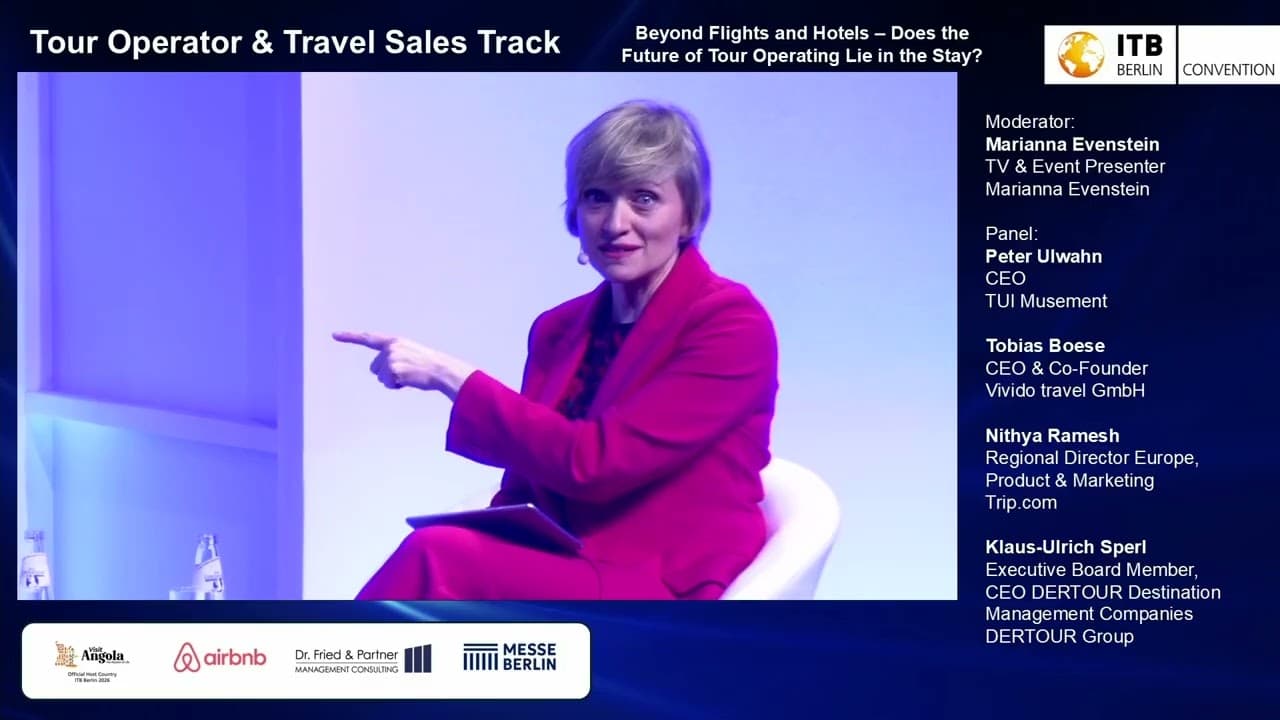
This panel at ITB Berlin 2026 explored the critical success factors for AI-driven sales in the travel industry, moderated by Marianna Evenstein. The four panelists represented distinct vantage points: André Rangel de Sousa (CEO of Tripy.com, an AI-native travel platform), Jan-Frederik Valentin (Managing Partner at Ania Capital Partners, investor/evaluator), Christian Sabbagh (founder and CEO of Travel Soft Group, booking and pricing software), and Casper Maasdam (Managing Director Europe at Trip.com, one of the world's largest legacy-turned-AI-enabled OTAs).
The session opened with a fundamental debate: is there a meaningful difference between a company that uses AI and one built around AI from the ground up? André argued forcefully that legacy OTAs suffer from a critical problem — disorganized, siloed data. He pointed out that major platforms like Booking.com lack real-time pricing visibility, making genuine personalization impossible without building infrastructure from scratch. Christian countered that being embedded in a data ecosystem — even as a legacy player — is itself a powerful advantage when AI is layered on top.
Jan-Frederik offered an investor's perspective, noting that 'AI startup' is currently an extremely difficult label under which to raise funding, even for successful companies. He observed that the industry is maturing past the phase of LLM-wrapper startups that add no durable value. He predicted AI will drive operational efficiency gains of over 50% across travel organizations, and sooner than most expect.
Casper shared Trip.com's concrete AI journey: the company (founded 1999) began implementing AI in its processes around 2022–2023. Key customer-facing tools include 'Trip Genie' and 'Trip Planner.' He described how the platform uses predictive AI to offer contextually timed products — for example, surfacing a food tour recommendation to a customer identified as likely to be interested — with strong sales conversion results. He also emphasized AI's role in disruption moments such as flight cancellations, where real-time support drives long-term customer loyalty.
André provided a striking data point from Tripy.com: 50% of bookings on their platform come from recommendations, not user-initiated searches. A generic trip suggestion achieves a 1.2% click rate. However, once the system collects a minimum of 4 user interaction data points, the click rate nearly triples — demonstrating the compounding ROI of genuine personalization versus generic suggestions.
André also cited the cautionary example of eDreams, which was fined 9 million euros by Italian regulators for using technology to confuse consumers and optimize short-term upselling at their expense — arguing this represents the wrong use of AI.
Christian highlighted the back-office potential of AI, arguing that the biggest untapped value lies in software development acceleration, internal process automation, and the steering/monitoring layer connecting front office, connectivity, and data layers — not just customer-facing features.
The panel converged on a clear framework for evaluating AI investments: genuine AI solutions must solve a real problem; LLM wrappers built over a weekend with no data moat or unique problem-solving are 'gimmicks' with poor conversion metrics and no customer loyalty. Data ownership, real-time pricing access, and ecosystem integration were identified as the true moats.
Looking two to three years ahead, panelists predicted: the winning OTAs will be those who move beyond search-based paradigms to deliver deals and experiences consumers never imagined possible; agentic bookings (including packages) will represent a substantial share of travel transactions; and profitability impact — not just efficiency — will be the defining measure of AI success.
Key Takeaways
- •André Rangel de Sousa argued that legacy OTAs fundamentally cannot deliver genuine AI personalization because they lack organized, real-time data infrastructure: 'You go to booking.com, they don't have visibility of real-time pricing — so how are we going to give personalized trips for consumers if we don't build from the ground up?' He sees departing from search-based paradigms as the true disruption opportunity.
- •Tripy.com reports that 50% of its bookings come from recommendations rather than user-initiated searches, demonstrating that an AI-native product can structurally shift user behavior away from traditional search-and-browse patterns.
- •A generic recommendation on Tripy.com achieves a 1.2% click rate, but once at least 4 user interaction data points are collected, the click rate nearly triples. André called this 'huge for OTAs' because doubling or tripling click/conversion rates translates directly to significant revenue at scale.
- •Jan-Frederik Valentin predicted AI will drive operational efficiency gains of over 50% across travel organizations, and 'more quickly than we maybe all think.' He noted conversion rate is the primary KPI B2B AI suppliers must still demonstrate to large OTAs like Trip.com, Booking, and Go.
- •Jan-Frederik described the current investment climate: 'It's super hard right now to raise money even if you're very very successful with AI because the big investors will say but how about tomorrow — is Anthropic going to kill everything?' Funding for AI travel startups is nearly drying up, rewarding incumbents with data moats.
- •Christian Sabbagh of Travel Soft Group argued that ecosystem integration — connecting front office, connectivity, pricing data, and the steering/monitoring layer in between — is a prerequisite for effective AI recommendations. 'Without that, because to have a right recommendation you need to understand the behavior of a traveler, access his past data, market data, products, pricing, and availability.'
- •André cited eDreams as a cautionary tale: the company was fined 9 million euros by Italian regulators for using technology to confuse consumers and optimize short-term upselling. He argued AI must be used for long-term consumer benefit, not to exploit search-phase desperation.
Transcript
And I am really excited to be moderating this next conversation because it feels particularly timely. We all know that travel is one of the most complex and fastm moving industries in the world and like so many other industries AI is starting to change almost every aspect of the travel business. So from how trips are being built uh and priced to how they're sold and also serviced. But we have to remember that not all change is necessarily good. Not all change necessarily creates advantage. So to...