The Future of Cruise Distribution – Online and Direct Channels in Focus
Summary
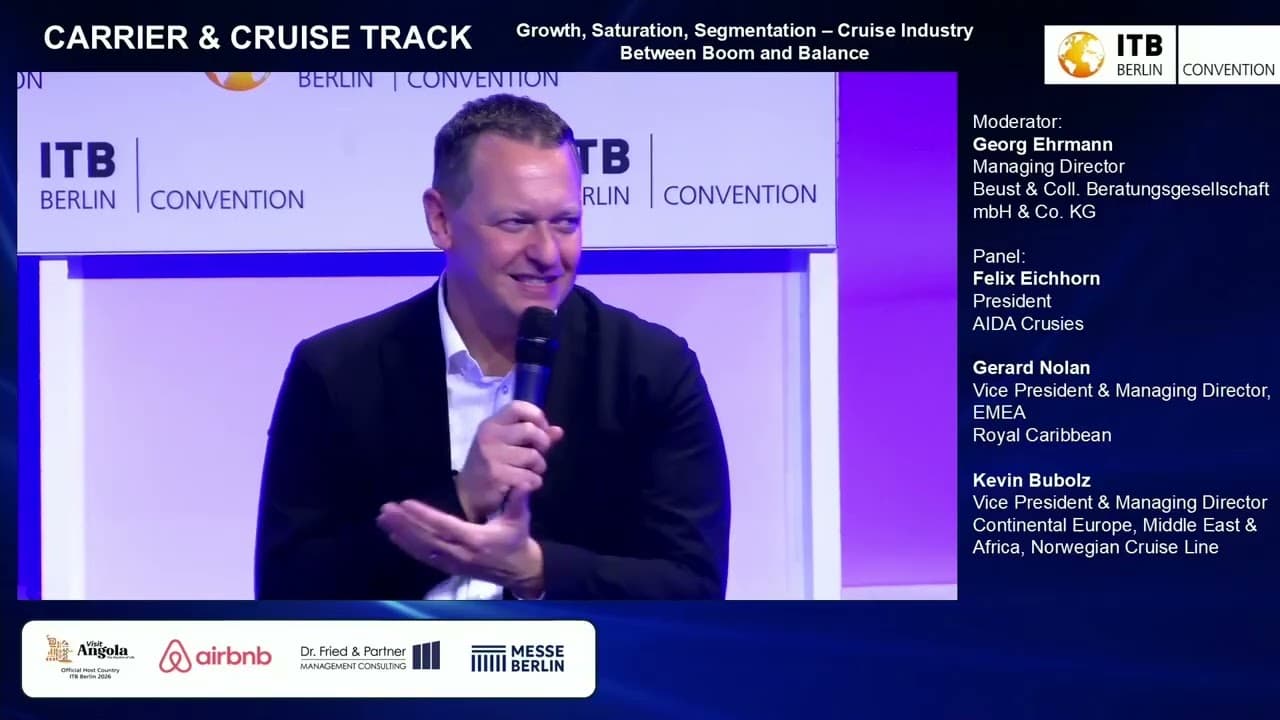
This panel session at ITB Berlin 2026, moderated by Georg Ehrmann, examined the future of cruise distribution with particular focus on the tension between growing online channels and the inherent complexity of cruise products. Detlev Schäferjohann (CEO, eHoy GmbH — a cruise-focused OTA) opened with a set of theses framing the core challenges: complexity, market dynamics, the value trap, and AI disruption. He highlighted that Germany's cruise OTA landscape has shifted dramatically with Check24 — the country's largest package holiday OTA — entering the cruise market, which he frames as both competitive pressure and a strategic opportunity to convert traditional package-holiday customers into cruisers.
A key concern he raised is the 'value trap': the industry risks eroding the premium, luxury-adjacent image of cruising through aggressive price competition and flash discounts, which he argued is unsustainable and brand-damaging. Alexander Ewig (SVP Marketing & Sales, AIDA Cruises) articulated a clear and direct strategic position: AIDA maintains one uniform price across all distribution channels — no cashbacks, no rebates, regardless of partner size. He reframed product complexity as 'freedom of choice,' arguing that technology now enables individualized experiences at scale that previously only expert travel agents could deliver.
Christian Kaatz (CEO, Antón Guten GmbH Europe / CroisiEurope) — Europe's largest river cruise operator with 55 ships — described digital distribution as a pure opportunity, noting that even the best travel agent rarely knows all 55 vessels, whereas an OTA displays the full portfolio instantly. He confirmed an emerging hybrid model: customers research online, view the full fleet, then phone a call center for final advice and booking. Polina Weber (Industry Manager Travel, Google) contributed data-driven insights: the average age of a German cruiser has dropped from 66 to 49 years in just a few years, signaling a rapid influx of digitally-native buyers who use YouTube, AI overviews, and AI mode for inspiration and deep research.
She noted that despite digital research dominance, slightly above 50% of cruise purchases in Germany still occur offline (ROPO effect). She argued that personalization — using first- and third-party data to deliver targeted spa vouchers, dining offers, or experience-specific incentives — represents 'the new luxury,' far more valuable than generic cashbacks. On AI, Weber disclosed that Google introduced a Universal Commerce Protocol (UCP) for agentic purchasing in January 2026 in the US and is actively exploring its application to travel.
Schäferjohann predicted his company will look completely different in five years but expressed skepticism that AI agents will autonomously book cruises because the cruise is typically the largest annual expenditure for a family — requiring personal decision-making. He also raised an unresolved legal question: if an AI agent assembles a dynamic package and the flight is delayed, which AI provider is liable for rebooking costs? The panel closed with consensus that the future belongs to those who intelligently manage complexity while combining digital efficiency with trust and brand integrity.
Key Takeaways
- •Check24, Germany's largest package tour OTA, has entered the cruise market, creating new competition for specialized cruise OTAs like eHoy but also potentially expanding the total cruise customer base by converting hotel-based package holiday buyers.
- •AIDA Cruises enforces a strict single-price policy: every distribution partner — from a small independent travel agency to a major OTA — receives the exact same product at the exact same price. No cashbacks or rebates are permitted under any circumstances, and violations are treated with maximum seriousness regardless of partner size.
- •The average age of a cruiser in Germany has dropped from 66 to 49 years in recent years, driven by Millennials and Gen Z entering the market. These buyers are digital natives who use YouTube creators for micro-inspiration and AI overviews for deep research before booking.
- •Despite heavy digital research activity, slightly above 50% of cruise purchases in Germany still happen offline (ROPO effect), validating a hybrid digital-inspiration / offline-conversion model.
- •Detlev Schäferjohann (eHoy) predicted with 100% certainty: 'Five years down the road, our company will be completely different from what it is right now.' He attributes this to AI fundamentally reshaping the OTA model, not just incrementally improving it.
- •Schäferjohann raised an unresolved legal challenge in agentic AI travel: if an AI agent (from OpenAI, Anthropic, Google Gemini, or another provider) assembles a dynamic cruise package and the flight is delayed, the AI provider is unlikely to absorb rebooking costs — creating an accountability gap that the industry has not yet addressed.
- •Google introduced a Universal Commerce Protocol (UCP) enabling AI agents to complete end-to-end purchases for retailers in the US in January 2026, and is actively exploring equivalent capabilities for travel. Polina Weber declined to predict a majority shift to agentic bookings within one year but confirmed early adopters exist.
- •Personalization is positioned as 'the new luxury': a generic cashback during booking feels forgettable, but using first-party data (search history, YouTube behavior, past onboard choices, dining preferences, spa treatments) to deliver targeted personal offers creates a premium experience. Weber stated: 'Finally we are at the stage where we actually can act on it' — after years of personalization being theoretical.
Transcript
Welcome to our session, the future of cruise distribution, online and direct channels in focus. My name is Gayok Airman. It's a pleasure to moderate this session. Cruise industry, we heard it just before, is one of the fastest growing segments in global tourism. But there is a paradox. The product is becoming more complex while customers expectations for simplicity are increasing. Hundreds of itineraries, dynamic pricing, cabin categories, packages, pre and post programs, and at the same time, o...