From Pilot to Payoff: 7 Pattern-Matched Traits of AI Systems That Actually Work
Summary
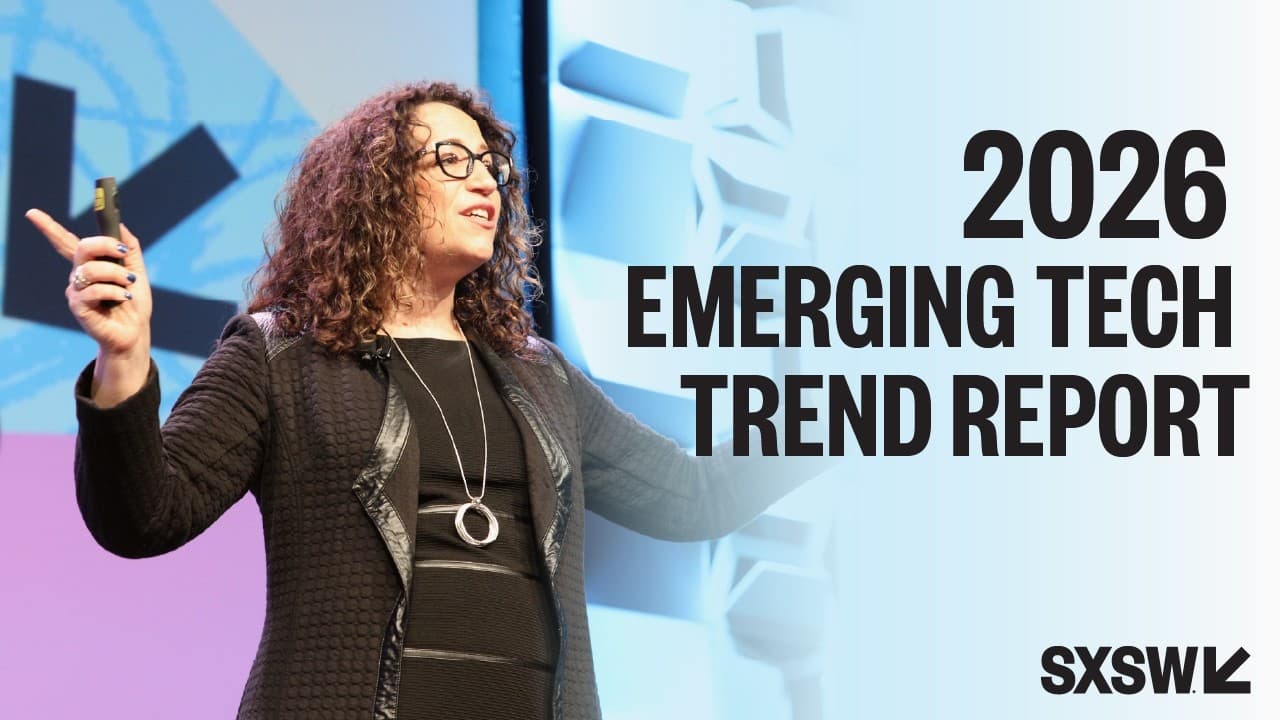
Sandy Carter, Chief Business Officer at a unicorn software company and AI practitioner since 2013, delivered a closing keynote at SXSW 2026 presenting a seven-part framework for moving AI projects from perpetual pilot status to measurable ROI. Drawing on research across 450+ companies and 1,500 survey respondents, she opened with a striking data point: an MIT report found 95% of AI pilots today are failing to produce return on investment — and the primary cause is not the technology, but the human and organizational factors surrounding it. Her framework challenges the conventional approach of starting with platform selection and instead argues for a people-first, then process, then platform sequence.
The first two pillars address leadership and agents. Carter cited WalkMe research showing only 3 of 20 CEOs at Davos had used AI in the past week, yet data demonstrates that CEOs who actively use AI for prompting and agentic tasks make their organizations 5.2 times more likely to succeed with AI projects. She highlighted a trust gap — 65% of executives trust AI outputs while only 17% of employees do — and recommended cross-functional 'promptathons' modeled on Mass General Hospital's approach involving clinicians at every level. On skills, 77% of executives cite adoption (not tooling) as their primary challenge, and 54% of workers stopped using AI tools last month and reverted to manual work. She praised NT Data's gamified 'black belt' training system as a model for driving enablement. For agents, she invoked Jensen Huang's declaration that OpenClaw is 'probably the single most important release of software ever,' and demonstrated her own agent implementations: a synthetic AI futurist built from 500 female futurists using 36 strategic frameworks, a book-companion agent serving 2,500 daily users, and a personal morning briefing agent that synthesizes 50,000 overnight news articles. Her own customer service agent handles 47% of all support queries for 4.8 million customers while raising customer satisfaction scores by 4%.
The fourth pillar — 'kill the pilot, fund the production' — identified three differentiators of the 20% of companies that successfully scaled AI: domain-focused business outcomes, data quality, and change management. Carter profiled Michael, a Dutch cardiologist who won third place at an Anthropic hackathon against hundreds of engineers purely through domain expertise, and storytown.ai, a Hollywood-producer-built tool using AI to augment screenwriting. On data, she referenced Davos research showing that for every $2 spent on AI by successful organizations, $2.50 goes to data infrastructure. A cautionary change management story involved a manufacturer who spent nine months building an IoT mood jacket for workers but only two hours on rollout training — employees sabotaged the sensors with hot tea and ice packs, forcing a full restart. The fifth pillar, governance, was co-presented with Kristen Smith (CEO of Utopic), who live-demonstrated a blockchain-based agent identity and permissions system — a preventive governance layer showing that only 15% of successful AI spending goes to model inference, while 85% goes to integration, governance, and compliance. Carter predicted that by 2027, companies without enterprise-grade agent governance will not be competitive.
The sixth pillar introduced world models as the next ROI frontier: unlike LLMs that pattern-match on static text data, world models are trained on cause and effect and can predict novel scenarios. BMW now builds every car twice using Nvidia world models for digital twins across 30 factories, reducing decision time by 30% on average and delivering 3-5x faster ROI. The seventh and final pillar returned to humans: only 15% of the world's knowledge is digitized, meaning AI models are trained on a fraction of human understanding. Carter argued that the remaining 85% — intuition, cultural knowledge, judgment, domain expertise — is the next competitive moat. She cited LinkedIn data showing job postings for storytellers have doubled since the AI era began, and Indeed data showing developer employment has grown exponentially (the Jevons Paradox at work). Accenture, Elation, and BMW data consistently show 38-85% higher productivity when humans and AI work together versus AI alone. Carter closed with a message of measured urgency: most people are dramatically overestimating how far ahead their peers are with AI, while underestimating the accelerating advantage available to those who start today.
Key Takeaways
- •95% of AI pilots are failing to produce ROI according to an MIT report, but the root cause is organizational and human factors — not the technology itself.
- •CEOs who actively use AI for prompting and agentic tasks make their organizations 5.2 times more likely to succeed with AI projects, versus 1.6x for prompting alone.
- •Only 3 of 20 CEOs at a Davos roundtable had used AI in the past week, revealing a critical leadership engagement gap that directly suppresses enterprise ROI.
- •A trust gap exists between executives (65% trust AI outputs) and employees (17% trust AI outputs) — employees know about the workarounds and manual overrides happening under the surface.
- •54% of workers stopped using AI tools last month and reverted to manual work; 77% of executives say adoption — not tooling — is their number one AI challenge.
- •Sandy Carter's own customer service AI agent handles 47% of all support queries for 4.8 million customers while raising customer satisfaction scores by 4%.
- •OpenClaw became the fastest-growing open-source project ever, reaching 100,000 GitHub stars in under a week, with 210 agents and 200 communities forming within 48 hours of launch.
- •Only 20% of companies surveyed (out of 1,500) successfully moved an AI project from pilot to production; those that did focused on business outcomes, data quality, and change management.
- •Domain expertise is now the scarce resource: a Dutch cardiologist with no coding background won third place at an Anthropic hackathon against hundreds of engineers by 'falling in love with the problem.'
- •Successful AI companies spend 15% of AI investment on the model/inference layer and 85% on governance, integration, and compliance — companies that fail optimize the inverse.
Transcript
Thank you, Greg. And thank you, South by Southwest. Haven't they done a great job? >> Okay, now I know we have Brazil in the room. So, that was not very well done. So, let's give it up for South by Southwest. >> There we go. Awesome. Awesome. Thank you guys. Okay. Well, we're going to have fun today. I know we have like the closing keynote, I think, but we're going to pump up the energy. You guys are going to learn a lot and have a lot of great takeaways. As Greg said, I am the chief business of...