AIE Europe Keynotes & OpenClaw ft Deepmind, OpenAI, Vercel, @pragmaticengineer , @mattpocockuk
Summary
This recording covers the full first day of AI Engineer Europe 2026 in London—the conference's inaugural European edition. The day featured opening keynotes and closing talks from leaders at Vercel, Google DeepMind, OpenAI, and Cloudflare, with a strong thread around agentic software, OpenClaw security, and the enduring importance of software fundamentals.
Malte Ubl (CTO, Vercel) opened by arguing AI agents represent a new application layer that makes previously uneconomical automation viable. He cited Vercel's contact-sales agent (75% deflection rate) and support agent (90% deflection rate), and revealed that over 60% of page views on vercel.com in the prior week came from AI agents rather than humans. He argued Europe leads AI engineering innovation, citing Vercel's AI SDK (10 million downloads/week), Pi (Austria), and OpenClaw, and predicted model commoditization will preserve engineer leverage at the application layer.
Raia Hadsell (VP Research, Google DeepMind) presented three non-language-model breakthroughs. Gemini Embeddings 2 is a fully omnimodal embedding model encoding up to 8,800 tokens of text, 128 seconds of video, 80 seconds of audio, and a full PDF in one unified vector using Matryoshka Representation Learning (MRL) from 256 dimensions upward. DeepMind's FGN (Functional Generative Network) directly predicts cyclone trajectories and wind speeds—already deployed at the US National Hurricane Center—while predecessor Gencast beat 97% of 1,300 physics-based forecasts, producing 15-day global forecasts in 8 minutes on a single chip. Project Genie 3 is an interactive, real-time, photorealistic world-generation model now available to Gemini Ultra subscribers.
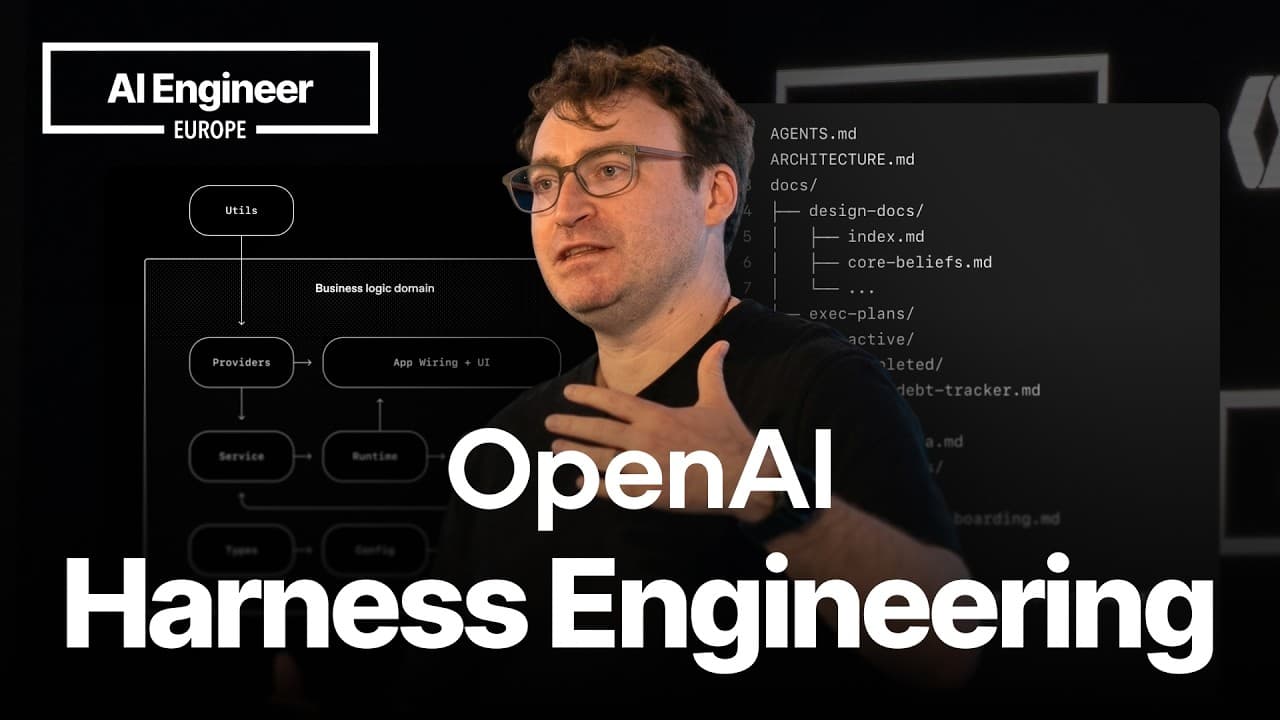
Ryan Lopopolo (OpenAI) described nine months building software exclusively with agents ('harness engineering'). He declared 'code is free' since GPT-5.2 and recommended encoding non-functional requirements (timeouts, retries, 350-line file limits, security interfaces) as lints and tests that continuously prompt agents. Reviewer agents inject PR comments agents must address before merge; product-minded engineers document QA plans once so every agent trajectory benefits.
Peter Steinberger (OpenAI, OpenClaw creator) gave a 'State of the Claw' update: ~30,000 commits, ~2,000 contributors, and 30,000 PRs in five months—calling it GitHub's fastest-growing software project. He reported 1,142 security advisories (16.6/day; 99 critical)—twice curl's lifetime total—and argued most high-severity reports are AI-generated slop. He described the 'lethal trifecta' of agentic risk: personal data access + untrusted content + communication ability. He is forming the OpenClaw Foundation (modeled on Ghost) with contributions from Nvidia, Microsoft, Tencent, and Bytedance.
Sunil Pai (Cloudflare) presented 'Code Mode': LLMs generate JavaScript executed in V8 isolates instead of emitting JSON tool calls. He demonstrated reducing Cloudflare's 2,600-endpoint API surface from 1.2 million tokens to ~1,000 tokens using two code-accepting tool calls (search and execute)—a ~99.9% reduction. He described Kenton Varda's emergent tic-tac-toe demo where Opus 'inhabited the state machine' with no game code present, and outlined a capability-based sandbox: no capabilities by default, explicit grants, full observability, nanosecond V8 isolate startup.
Matt Pocock (AI Hero, Total TypeScript) challenged specs-to-code vibe-coding, arguing software fundamentals matter more than ever. He cited Ousterhout on complexity, the Pragmatic Programmer on entropy, Brooks on shared design concepts, and DDD ubiquitous language. His Claude Code 'grill me' skill—adversarial requirements gathering that asks up to 100 questions before coding—reached 13,000 GitHub stars. He concluded: 'Bad code is the most expensive it has ever been,' because a hard-to-change codebase prevents capturing AI productivity gains.
Key Takeaways
- •Over 60% of page views on vercel.com now come from AI agents, not humans — design APIs and CLIs before UIs.
- •Gemini Embeddings 2 supports a single vector for 8,800 tokens of text, 128s of video, 80s of audio, and a full PDF using Matryoshka Representation Learning for variable-dimension retrieval.
- •DeepMind's FGN model directly predicts cyclone trajectories, beating physics-based models by 3 days (6 vs. 9 days) and producing 15-day global forecasts in 8 minutes on one chip.
- •Encode non-functional requirements (timeouts, retries, file-length limits, security interfaces) as lints and tests so they continuously prompt-inject agents without human review.
- •Reduce large API surfaces (e.g., Cloudflare's 2,600 endpoints / 1.2M tokens) to ~1,000 tokens by exposing two code-accepting tool calls (search and execute) instead of per-endpoint tools.
- •OpenClaw receives 16.6 security advisories per day (1,142 total); the higher the alarm, the more likely it is AI-generated slop — use Nvidia engineers for triage at scale.
- •The 'lethal trifecta' of agentic risk: personal data access + untrusted content input + ability to communicate externally — applies to any powerful agent system, not just OpenClaw.
- •Bad code is the most expensive it has ever been — a hard-to-change codebase prevents you from capturing AI's productivity gains; deep modules with simple interfaces compound AI performance.
- •DDD ubiquitous language (shared terminology markdown) fed to the LLM reduces verbosity and aligns implementation with intent; use 'grill me' to reach a shared design concept before coding.
- •TDD forces small deliberate steps: the rate of feedback is the LLM's speed limit; let it generate code only to make a specific failing test pass.
Transcript
Hey, hey, hey, hey, hey, hey, hey, hey. Hey, hey, hey. Yeah. Hey, hey, hey. Heat. Hey, Heat. Hey. Hey. Hey. Heat. Heat. Heat. There is no good. There is no pure only fores out of You called it virtue because it felt light. You called it evil when it cut too deep. But nothing here was born to save you. Nothing here was built to care. Every function has a shadow. Every strength a road somewhere pushing for break the bra you know God is good no force is Every system fails when it leaves. There is n...
Topics
Related Sessions