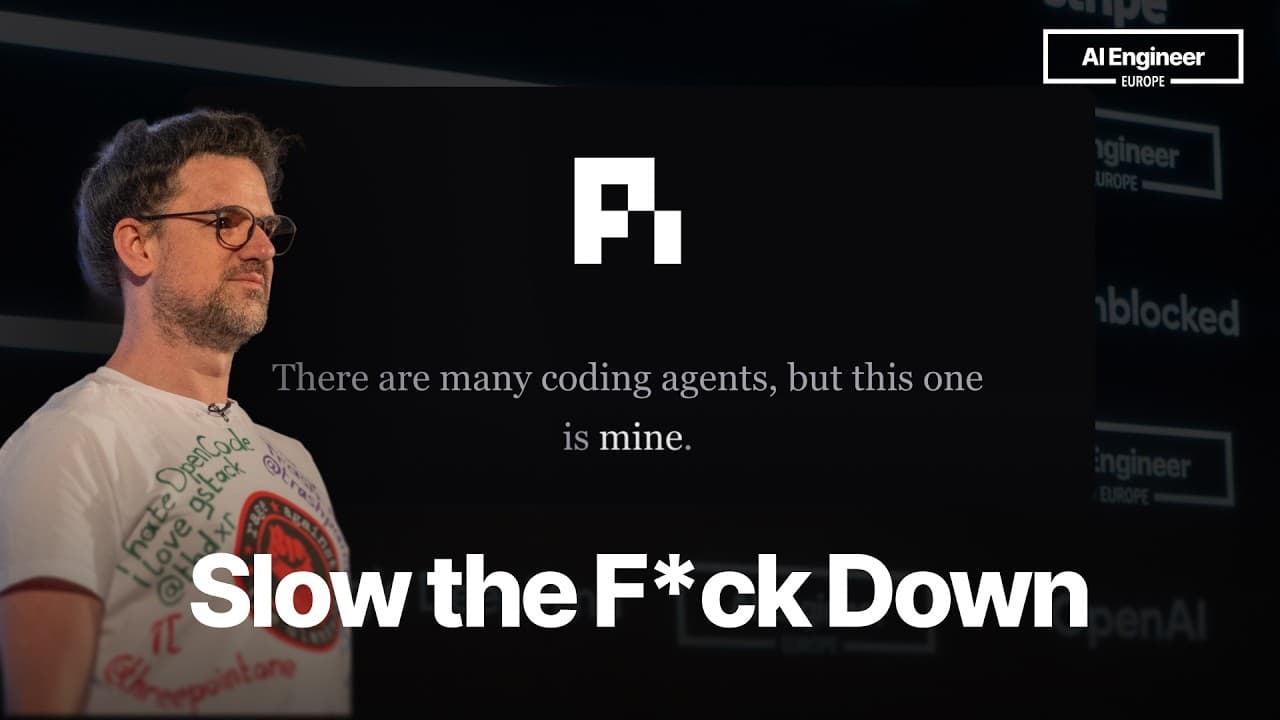
The End of Apps — Kitze, Sizzy.co
Summary
Kitze (founder of Sizzy.co and creator of apps Benji, Better, and others) delivers an autobiographical keynote tracing his lifelong obsession with productivity tools and personal agents, arguing that the current era of discrete consumer apps is coming to an end. He frames his talk as a journey from a 10-year-old writing to-do lists in a notebook, through two decades of failed personal productivity experiments, to his present-day exploration of AI personal agents.
Kitze recounts building a series of productivity apps — TodoDoIt (2016, priority-weighted task surfacing), Better (habits + planner + to-dos), and Benji (an all-in-one life OS now spanning dozens of features) — each time abandoning or over-engineering the project due to ADHD-driven feature creep. He notes a key lesson: a competitor who took a single feature from his roadmap — food tracking via phone camera for calorie analysis — made multi-millions while he accumulated 60 features and shipped nothing.
The ChatGPT plugins moment in 2022–2023 (which he correctly identifies as the precursor to MCP) triggered his first major conviction that "apps are over," a belief his wife now dismisses because he calls her with such announcements every few months. He describes the difficulty of coaxing early models to return valid JSON, noting that developers had to "bully the models" to avoid markdown responses. He built a voice-to-API feature in Benji where periodic microphone captures drove live calendar and to-do mutations — a prototype that went viral on Twitter but was never shipped.
Kitze then details his adoption of Claude Code with personal skills, his discovery of the Open Claude (lobster-themed) community and its Telegram/WhatsApp-based personal agent setup, and his subsequent "full hipster mode" — switching to Android for notification access, self-hosting everything on a local NAS, and moving to local markdown files for AI-accessible data. He created multiple specialized Discord bots covering different life domains (work, personal, fitness, etc.) but found the approach produced chaos rather than clarity: missed mortgage payments, late customer emails, and a community that went from explosive growth to five-person "Open Claude Anonymous" meetups.
He identifies core reliability problems: cron jobs failing silently, multi-agent memory loss (agents forgetting context from the message immediately above), and Discord/Telegram being fundamentally the wrong UI for a life OS. He also critiques cloud-hosted agent products (e.g., Cohere's agent) as too neutered compared to self-hosted setups.
Kitze describes building his own personal agent framework, Wolfer, as an experiment (currently only for himself, running on Codex since he fears using Claude Code's REST API). Its key architectural ideas: nested topic trees where each conversation automatically injects parent-topic descriptions as context rather than relying on fallible memory retrieval; visible and collapsible tool-call UI; predictable cron job labeling; per-agent capability management in a sidebar; and an inline knowledge base with markdown documents that can be @-mentioned in any conversation.
His closing prediction is that the role of AI will invert: instead of users prompting AI, the AI will prompt users — surfacing the next task, requesting missing inputs, and operating continuously in the background. He foresees most consumer apps disappearing as OS-level local agents (potentially Apple winning due to strong on-device models and app integration via local tool capabilities) handle normie workflows through dynamically generated UI. Specialist software for domains like video color grading or music production will survive, but general-purpose apps will not.
Key Takeaways
- •Building 60 features instead of shipping one focused product is a losing strategy — competitors monetizing a single feature (food photo calorie tracking) made millions while Benji stagnated.
- •Discord and Telegram are the wrong substrate for a personal life OS; they are coping mechanisms until dedicated agent-native UIs exist.
- •Nested topic trees that auto-inject parent context outperform memory retrieval systems for agent coherence — no memory system currently reliably pulls the right context at the right time.
- •Cloud agent products (e.g., Cohere's agent) are too constrained to satisfy power users; self-hosted setups offer far more capability but require tinkerer-level maintenance most people will never do.
- •The AI prompting model will invert: future productivity means AI prompts you with the next task, and you make decisions — rather than you prompting AI all the time.
- •On-device local models make Apple a plausible winner for mainstream AI agents, since Siri with app-level tool access requires no cloud credits and keeps data local.
- •Most consumer apps will disappear for normies; specialist tools (video editing, music production) will survive but general-purpose apps will not.
- •Switching to Android is worth it if you need your agent to read, clear, and act on mobile notifications — iOS severely limits this capability.
- •When building personal agent infrastructure, prefer predictable UI with visible tool calls and labeled cron messages over opaque message streams — debugging is otherwise impossible.
- •Agent reliability problems (silent cron failures, cross-message memory loss) are still the primary blocker for personal agents reaching mainstream viability.
Transcript
Wow, backroom. Those are not my slides. There you go. Hi, I'm Kitze. We probably argued on X and the Kitze on X and I turned 34 years old today. Decided to do a talk on my birthday because [ __ ] it. Thank you. I like to torture myself by asking, do we have anyone from Tinker Club here? Please. Just a person sleeping in the back is like, oh, what did he ask? All right. I formed this recently. It's an awesome community where every person inside is copy and paste of everyone inside is hilarious to...
Topics
Related Sessions