Geopolitical Shifts and the Emergence of a New World Order: Strategic Implications for Tourism
Summary
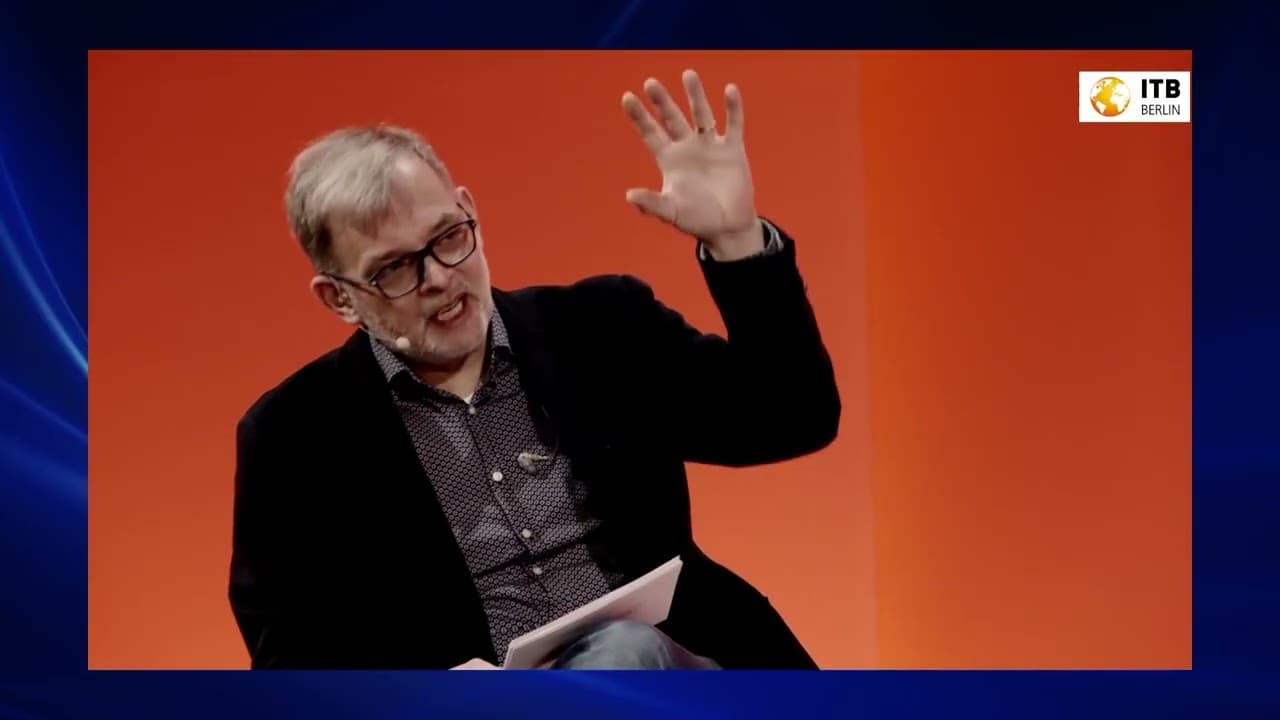
Joschka Fischer, former German Foreign Minister and Vice Chancellor, delivered the opening keynote at ITB Berlin 2026, offering a sobering geopolitical analysis and its direct implications for the global tourism industry. Fischer's central thesis is that the rules-based international order — which underpinned decades of stable global mobility — is effectively over, replaced by a power-based order defined by the rivalry of major states, primarily the US and China, with Russia as a destabilizing 'troublemaker' and India emerging as a future power. Europe, Fischer argued pointedly, is not yet a power in military or political terms, prompting audience laughter when he confirmed the EU simply does not qualify as a global power under this framework.
Fischer focused heavily on the Gulf region as a live case study. He described Dubai — long a flagship tourism destination and aviation hub — as now 'a place of war and threat,' warning that the major Gulf airport hubs (Dubai, Doha, Abu Dhabi) are effectively blocked by the current conflict. He was explicitly pessimistic about the outlook, stating he does not expect a short war or a smooth outcome. He raised the possibility of Iranian state disintegration, citing deep ethnic tensions (Baluchistan, Kurds), mass violence (referencing approximately 60,000 people shot in the streets during recent unrest), and the risk of prolonged civil war. Iran's fragmentation, he warned, would destabilize the entire Gulf region — not just as a tourist destination but as 'the gas station of the world economy.'
On China-US rivalry, Fischer predicted ongoing confrontation — possibly not military but certainly political — and cited a concrete tourism impact: Japan's inbound Chinese tourism 'almost collapsed' after the Japanese Prime Minister made statements about defending Taiwan, demonstrating how political rhetoric alone can devastate tourism flows. He characterized US leadership under Trump as 'unpredictable and contradictory,' calling Trump's Greenland annexation idea 'crazy' and a betrayal of a close NATO ally, drawing audience applause. He stated flatly that Trump is 'saying goodbye to the transatlantic relationship' and that Europeans are, for the first time in history, effectively alone.
Fischer drew on a personal experience from Christmas Day 2004 when the Indian Ocean tsunami struck while he was Foreign Minister, catching European diplomatic missions completely off-guard with tens of thousands of European tourists in affected areas. This led to a structural overhaul of crisis response between government and industry — a model he explicitly recommended for the current era. His core recommendation to the tourism industry was to invest heavily in geopolitical literacy at the leadership level, build robust crisis reaction capabilities, and accept that increased insecurity is a permanent feature of the new world order — not a temporary disruption. He was unambiguous: 'there will be no way back to the old order.'
Key Takeaways
- •Fischer declared the rules-based global order is over: 'The time when a rules-based order was defining the reality on the global stage seems to be over.' The replacement is a power-based order of big global powers — US, China, and eventually India — where rivalry and conflict will be more frequent than in the past.
- •The Gulf conflict is causing immediate, severe tourism damage: Major airport hubs in Dubai, Doha, and Abu Dhabi are effectively blocked, severing key transit routes between Europe and Southeast/East Asia. Fischer called Dubai 'a place of war and threat' and warned customers 'are not paying for risking their lives in a beautiful hotel.'
- •Fischer was explicitly pessimistic about a near-term Gulf resolution: 'I'm pretty pessimistic that this will not be a short war and I don't think there will be a smooth outcome.' He expressed serious concern about Iranian state cohesion given ethnic fragmentation and the extreme domestic violence, including approximately 60,000 people shot in the streets during the uprising.
- •Political rhetoric alone can collapse tourism markets: Fischer cited Japan as a direct example — Chinese tourism to Japan 'almost collapsed' after the Japanese Prime Minister made statements about Taiwan, showing that even words (not just military action) can devastate bilateral travel flows.
- •Fischer's Saturday morning reaction to the Gulf escalation was: 'I expected it.' He said the combination of the public uprising, brutal repression, and Netanyahu's Washington visit made an escalation predictable for those tracking geopolitics closely — underscoring his argument that tourism leaders must follow diplomatic developments in real time.
- •Fischer flatly stated: 'The European Union is not a power.' In military terms and political terms it is not constructed for power — it was built for economics, finance, and rule of law. Power in Europe will depend on larger nation-states, specifically the Germany-France-UK (E3) axis, which has grown closer under Russian invasion pressure.
- •Trump's Greenland annexation idea was called 'crazy' by Fischer: 'Denmark was one of the closest allies of the United States after the Second World War. And suddenly Trump had the idea that the US had a lack of ice bears.' He said Trump is saying goodbye to the transatlantic relationship and Europeans must recognize they are 'for the first time in our history, alone.'
Transcript
Welcome back everybody here at ITV Berlin. It's great to see you. A few new faces here, but always a full house. This is exactly the drive that we are looking forward to have here at ITV Berlin convention. Ladies and gentlemen, it's great to see you back. And now, as you can already see it on the screen, we are diving into a topic that is very much a topic of current affairs. When it we dive into geopolitical shifts and the emergence of a new world order, what are the strategic implications when...