The Outlook: How AI Redefines Travel
Summary
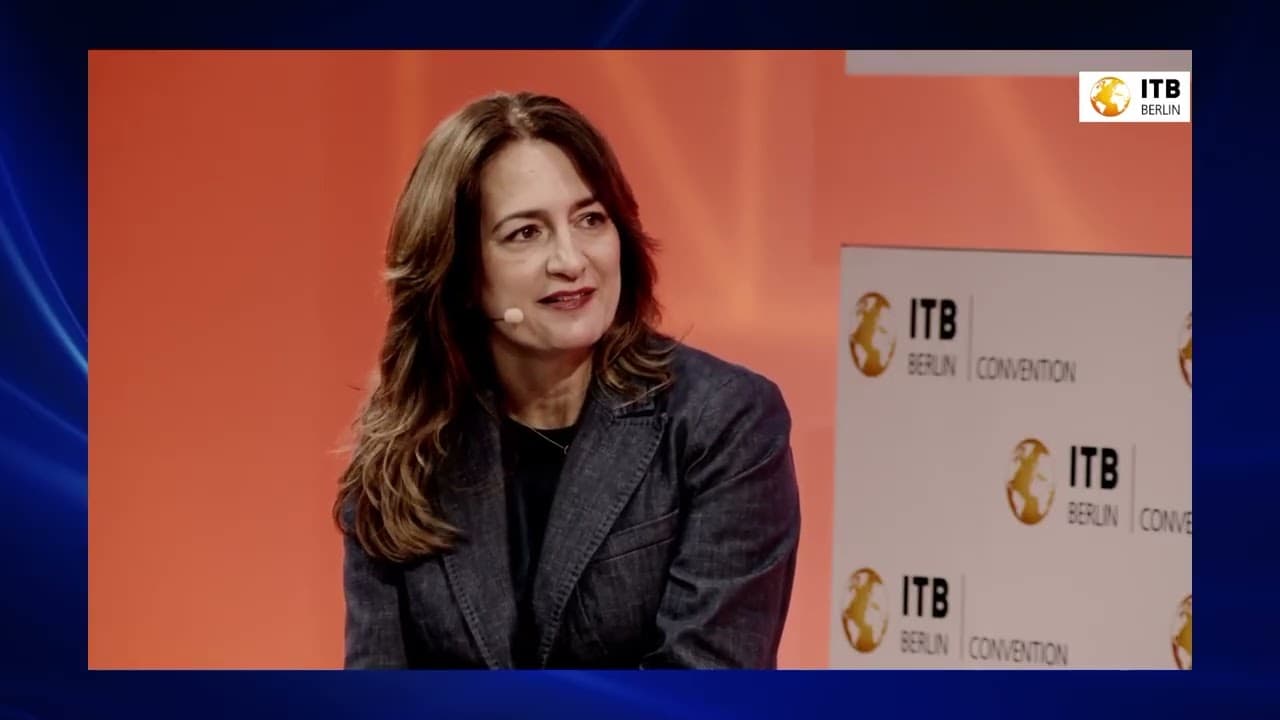
Mitra Sorrells, SVP of Content at Phocuswright, delivers a data-grounded opening keynote framing AI as travel infrastructure, not a feature. She opens by anchoring the discussion in Phocuswright's 40-market global research: total global travel bookings reached $1.93 trillion in 2024 and are projected to hit $2.14 trillion by 2027, measured across car, air, lodging, cruise, package, rail, and tours. Growth is uneven: mature markets like Europe and the US are seeing modest booking value increases driven by higher prices and luxury segment resilience, even as overall travel incidence is flat or slightly up due to inflationary household pressure. In contrast, the Middle East, India, and Latin America are growing at materially faster rates, powered by rising middle-class demand, digital adoption, younger populations, and in the Middle East's case, government-led infrastructure investment.
The structural argument of the talk centers on AI's transition from an experimental product feature to core distribution infrastructure — a 'control layer' between traveler intent and traveler decisions. Sorrells presents April 2024 consumer data from the UK, France, and Germany showing early AI travel adoption, but immediately notes that January 2025 Microsoft data puts general AI usage in those same countries at 28–44%, meaning the April 2025 Phocuswright Europe survey is expected to show materially higher numbers. In the US, where Phocuswright surveys more frequently, nearly one in two respondents (up from 33% a year prior) now use AI tools like ChatGPT, Google Gemini, or AI embedded in travel platforms for trip planning.
A notable demographic finding: while Gen Z might be assumed to lead AI travel adoption, it is millennials aged 30–45 who are currently the most likely users, citing time savings and information filtering. More strategically significant: US AI travel users are wealthier, travel more frequently, and spend significantly more per trip — making them the highest-value segment in the industry.
Sorrells discusses the shift from chatbots to agentic AI — systems that don't just answer questions but execute decisions including booking, payment authorization, and trip modification. She introduces the 'A2A' (agent-to-agent) acronym as a key concept and warns that visually compelling websites and apps will matter less in an agentic world: 'AI doesn't respond to visual hierarchy, immersive imagery, or clever copy. Being attractive to humans is no longer enough.' She cites Marriott CEO Anthony Capuano's recent earnings call language describing AI as a potential 'reset of customer acquisition' and IHG CEO Elie Maalouf's new content platform designed specifically to improve AI agent recommendation likelihood. Expedia CEO Ariane Gorin, while working with all major AI platforms, also flagged AI agents as a competitive threat.
On industry preparedness: 83% of travel businesses report using AI in some capacity, and over 60% are experimenting with agentic systems. Yet only 13% allocate more than 20% of their tech budgets to GenAI — highlighting a gap between stated priority and actual commitment. The constraint is no longer model capability but organizational mindset, with most companies retrofitting AI into existing tasks rather than redesigning work around AI's actual capabilities.
Sorrells closes on digital identity and monetization. EU digital identity mandates take effect by end of 2025. On monetization, she flags OpenAI's 4% transactional commission deal with Shopify as a new economic model — contrasting sharply with the ~20% OTA commission structure — while cautioning that all current predictions about who wins in AI distribution (hotels vs. OTAs) are speculative: 'If someone tells you they know exactly how to own visibility and conversion in AI, they are probably trying to sell you something.'
Key Takeaways
- •Global travel bookings totaled $1.93 trillion in 2024 and are on track to reach $2.14 trillion by 2027 across Phocuswright's 40-market measurement covering car, air, lodging, cruise, package, rail, and tours and activities.
- •AI travel adoption in the US has jumped from 33% to nearly 50% in one year, with European adoption expected to have risen significantly when Phocuswright's April 2025 survey is fielded — January 2025 Microsoft data shows 28–44% general AI usage in UK, France, and Germany.
- •Millennials (ages 30–45), not Gen Z, are currently the most likely demographic to use AI for trip planning, primarily citing time savings and the ability to cut through information overload.
- •US AI travel users are wealthier, travel more frequently, and spend significantly more on their trips — making AI-driven engagement a high-value segment opportunity, not just a convenience feature.
- •Marriott CEO Anthony Capuano described AI as a potential 'reset of customer acquisition' on the company's earnings call, and confirmed Marriott is optimizing content for generative AI and collaborating with Google and OpenAI to ensure property visibility in AI-powered search.
- •IHG CEO Elie Maalouf described a new content platform designed specifically to increase the likelihood that IHG hotels are recommended by AI agents — the first explicit mention of AI agent optimization in major hotel earnings calls.
- •Expedia CEO Ariane Gorin, while partnering with all major AI platforms, also explicitly named AI agents as a competitive threat — signaling that even major OTAs see agentic systems as a distribution risk.
- •83% of travel businesses report using AI in some capacity, and over 60% are experimenting with agentic systems, but only 13% allocate more than 20% of their tech budgets to GenAI — revealing a stark gap between stated priority and financial commitment.
- In an agentic AI world, visually designed websites and apps will matter less: 'AI doesn't respond to visual hierarchy, immersive imagery, or clever copy. Being attractive to humans is no longer enough. You have to be legible to machines.'
Transcript
But let's dive in with our day today and for that I welcome now the professor for destination management at Australia h a professor Dr. Hines diet kak. It's so nice to be back here with you on our favorite stage. So ladies and gentlemen, welcome to the future track and welcome to the ITB convention. It's a pleasure to see so many of you here today as we address one of the most critical challenges of our time in tourism that's leading tourism into balance. The word balance is no longer just a nic...