Moving Beyond the Front Desk: A Vision for Mobile, Guest-First Hospitality
Summary
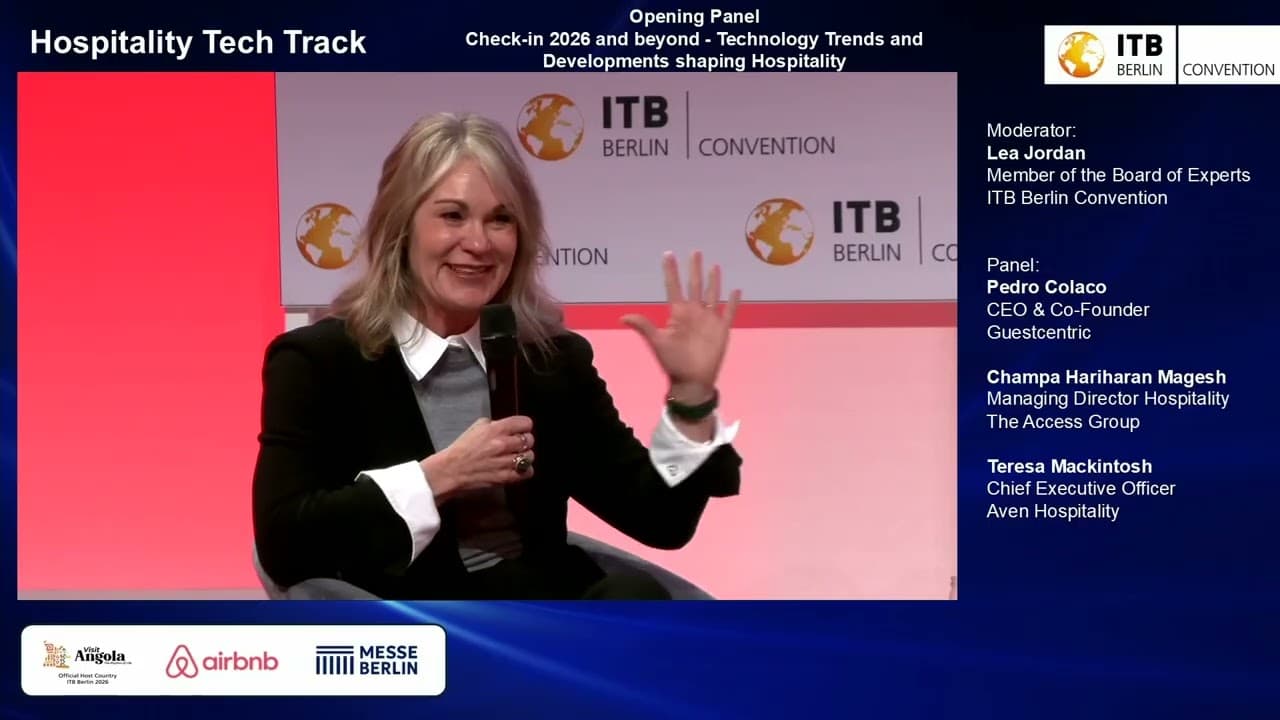
This fireside chat at ITB Berlin 2026 brings together Wolfgang Emperger, Senior Vice President of Europe and Africa at Shiji Group (which works with thousands of hotels globally), and Otto Konstantin Lindner, co-founder and Managing Director of Hospitality X (a portfolio of 8 hotels across Germany with varied ownership and consulting models), moderated by Lea Jordan. The conversation centers on moving hotel operations away from fixed front-desk infrastructure toward guest-centric, mobile service delivery.
Otto Lindner describes Hospitality X's philosophy of building individual, locally branded hotel concepts rather than franchising under global brands — a strategy he argues is more effective in the German-speaking market (DACH region) due to guests' growing demand for authenticity and unique experiences. Their Zippa Hotel and Apartments in Düsseldorf was designed from scratch as a fully digital, reception-free property: guests arrive pre-paid and checked in, receive mobile keys on their smartphones, and interact with all-rounder staff rather than role-specific front desk agents. At the other end of the spectrum, Hospitality X also operates what they call the largest resort hotel in the Black Forest, which retains a traditional reception because guests there expect in-person welcome and discussion of spa treatments and family activities. The portfolio also includes the world's first stadium hotel in Leverkusen, built around a sports and soccer experience concept.
Wolfgang Emperger focuses on systemic failures in hotel technology: the core problem is disconnected legacy systems — PMS, point-of-sale, spa booking, and reputation management platforms that do not communicate. He illustrates this with a personal anecdote: after staying 15 times at a Tier 1 global brand hotel in Katowice, Poland, serving as Shiji's European development hub, staff still greeted him with 'Have you stayed with us before?' — demonstrating that guest data exists but does not reach the people interacting with guests. He argues hotels need to make the technology and information follow the guest, not force guests to move to where the process happens.
Emperger cites a 2025 McKinsey study finding that a good guest experience drives guests to spend up to 5% more in retail environments — and suggests the uplift is even higher in hospitality. He uses McDonald's kiosk rollout as an industry analogy: widely perceived as a cost-cutting move, it was actually a revenue increaser that enabled table service, cross-language ordering across Europe, and brought staff from behind the counter to the front — resulting in higher costs but greater revenue and profit overall.
Both speakers converge on change management as the critical implementation challenge. Lindner describes the process of implementing Shiji as PMS at their Black Forest resort, where staff with 20–25 years of tenure needed to be brought along on the digital transformation journey. Emperger underlines that new software is only as good as vendor support plus internal hotel support — framing it as a genuine partnership rather than a technology installation. Looking five years ahead, Lindner predicts that differentiation will come from USP-driven, themed hotel concepts built around guest experience, location, property character, and event programming.
Key Takeaways
- •Hospitality X operates 8 hotels in Germany with fully individual brands and USPs rather than operating under global franchise flags. Otto Lindner argues that in the DACH market, authenticity and local identity outperform big-brand recognition — each property has its own brand, website, and technology stack built from the ground up.
- •The Zippa Hotel and Apartments in Düsseldorf was built as a fully reception-free property from greenfield. Guests arrive pre-paid and pre-checked-in with a mobile key on their smartphone. Otto Lindner recalls that when he and co-founder Tobias proposed this model, 'a lot of people said, No, that's not possible. You need a reception in the hotel.' — they proceeded anyway and proved it viable.
- •Wolfgang Emperger identifies the root cause of poor guest experience as disconnected legacy systems: 'The systems are dictating the process — not us as hoteliers, not the guest. We should follow the guest, not the system.' PMS, POS, spa systems, and reputation platforms operating in silos create fragmented journeys that no amount of staff goodwill can compensate for.
- •Emperger shared a personal example of staying 15 times at a Tier 1 global brand hotel in Katowice, Poland (Shiji's European development hub), and being asked 'Have you stayed with us before?' every visit. The data existed in the system but never reached the staff member at the door — a failure of information flow, not data collection.
- •A 2025 McKinsey study cited by Emperger found that delivering a good guest experience leads customers to spend up to 5% more in retail settings, with hospitality expected to see an even greater uplift. Emperger framed this explicitly as the business case for mobile, guest-first operations: 'It's about the revenue for the hotel. It's about the happy guest and the happy hotel.'
- •Emperger used McDonald's kiosk rollout as the definitive industry analogy for bold technology adoption: universally misread as cost-cutting, the kiosks enabled cross-language ordering across Europe, unlocked table service (previously unimaginable in QSR), and moved staff from behind the counter to the floor. The initiative cost more than expected but drove revenue and profit gains — 'a move in quick service restaurants that no one would have ever foreseen.'
Transcript
I said it. Moving beyond the front desk. A vision for mobile guest first hospitality. I would love that so much, right? Isn't that weird if you come to a hotel and you always get drawn like a magnet to this front desk and then someone's looking in the computer and can't really honestly engage with you? That's not really what hospitality should be, right? And to dig into that topic, we invited uh two thought leaders of the industry. We have and please welcome to the stage the senior vice presiden...