When the Hotel Sees You - Inside the Predictive Future of Guest Recognition and Augmented Reality
Summary
David Poprawka, Innovation Strategist at Infor Hospitality, presents a 17-minute keynote at ITB Berlin 2026 on the convergence of augmented reality (AR) and AI for predictive, guest-aware hospitality experiences. Infor is a cloud solution provider delivering PMS, POS, RMS, and broader hospitality technology.
Poprawka leads Infor's 'Moonshot Lab,' an internal innovation unit explicitly modeled on experimental R&D: he states bluntly that nine out of 10 moonshot projects fail, and frames this as a feature rather than a bug — each failure is a meaningful first step toward understanding what the industry actually needs.
The central problem he frames: hospitality has enormous volumes of data — PMS, CRS, loyalty, flight data — but that data is inaccessible at the precise moment it matters most: the service encounter. His project, named 'Project Beyond Sight,' is a working AR prototype designed to surface unified guest intelligence directly in the field of view of front-of-house staff, enabling them to maintain eye contact while receiving real-time contextual overlays.
The prototype architecture involves three layers: (1) AR hardware — initially Meta smart glasses, but expanded to include mobile phones running an APK, giving flexibility in jurisdictions with strict data protection laws; (2) AWS ecosystem integration for facial recognition and sentiment analysis — detecting emotional states including smiling and anger; and (3) a unified hospitality analytics and insights layer that consolidates data streams from PMS, RMS, restaurant reservation systems, and third-party sources like FlightRadar.
A concrete use case: a guest arrives whose flight was delayed. The AR system identifies the guest via facial recognition, pulls their profile including 15 prior stays, notes a missed dinner reservation at the in-house steakhouse, cross-references their FlightRadar flight data to confirm the delay, and proactively prompts the front desk agent: 'Would you like me to rebook this table?' The system also recalls that the guest consistently orders Bordeaux wine at the steakhouse.
A second use case targets back-of-house operations: AR (via phone or drone) scanning banquet rooms to detect missing cutlery, fingerprinted wine glasses, or incorrectly set tables. For housekeeping, the system provides a benchmark room scan completed in three seconds, flagging a crooked pillow, missing water glass, or missing pen, and automatically logging maintenance tickets into the PMS.
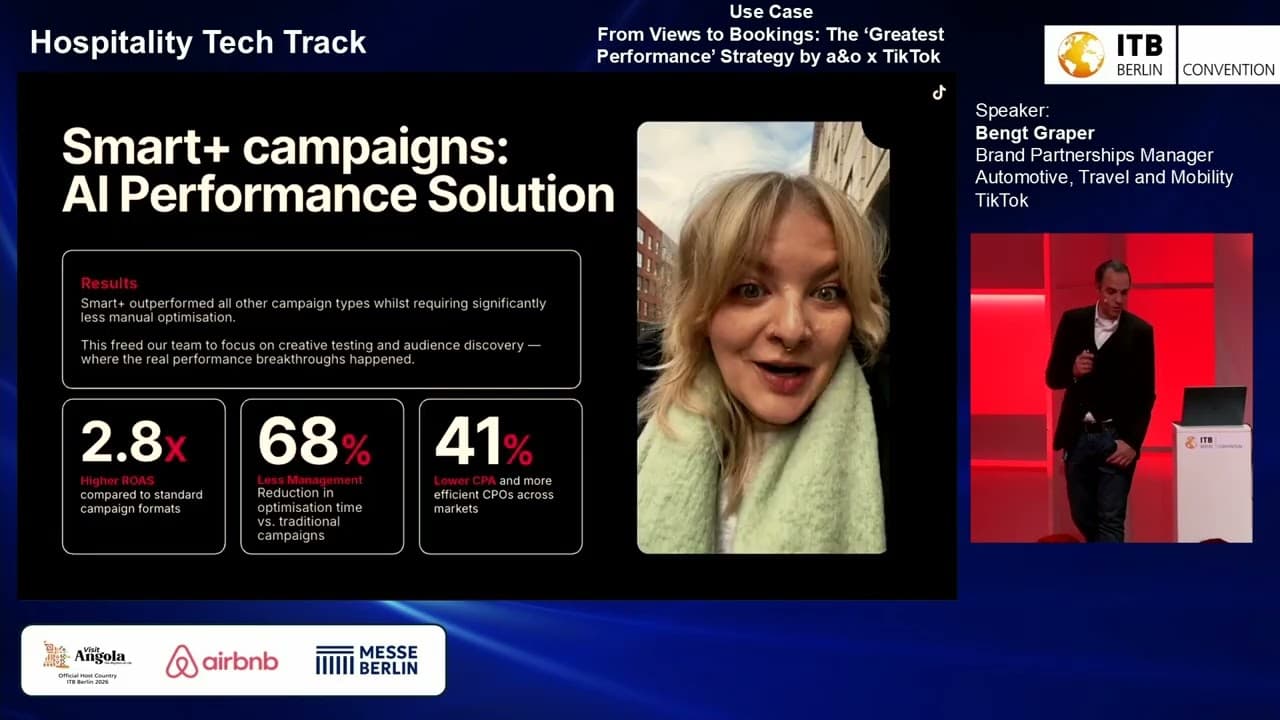
Poprawka delivers a pointed critique of the industry's AI purchasing behavior: most chatbot deployments are 'just GPT layers' exposing guest data to OpenAI to save five minutes at check-in — a trade-off he explicitly recommends against. His stronger argument: 'We don't need large language models in hospitality. We're not curing cancer. We're not finding new isotopes. We're checking people in and out.' He advocates for purpose-built, smaller, more differentiated AI products instead of LLMs, and recommends MCP (Model Context Protocol) as a preferred integration layer over APIs, which he characterizes as 'expensive, time-consuming, and unstable at best.'
The talk closes with a challenge to the audience: don't wait for vendors to invent what hotels need — build prototypes, fail fast, and return next year with a story.
Key Takeaways
- •Nine out of ten moonshot projects at Infor's innovation lab fail deliberately — Poprawka frames failure as necessary R&D progress, not waste: 'Even if that first step means this is not the way moving forward, we still have taken that first step.'
- •Hospitality is drowning in data (PMS, CRS, loyalty, flight APIs) but that data is unavailable at the service encounter — the exact moment it would create value. Project Beyond Sight is specifically designed to close this gap via AR overlays.
- •Poprawka explicitly recommends AGAINST deploying LLMs (like GPT) in hospitality: 'We don't need large language models in hospitality because we're not solving anything that's worth a large language model. We're not curing cancer. We're checking people in and out.' He advocates for smaller, purpose-built models instead.
- •Most hospitality chatbots are 'just GPT layers' that expose guest PII to OpenAI in exchange for saving approximately 5 minutes at check-in — Poprawka's personal recommendation is not to make that trade.
- •MCP (Model Context Protocol) is recommended as the preferred language for AI agents to connect to hospitality systems, replacing expensive and unstable API integrations.
- •The AR prototype runs on two hardware paths: Meta smart glasses for full hands-free overlays, and a phone-based APK for jurisdictions with facial recognition restrictions or staff preference — offering a privacy-first deployment option.
- •A concrete demonstrated use case: AR system identifies arriving guest, detects via FlightRadar that their flight was delayed, notes a missed dinner reservation, cross-references 15 prior stays showing preference for the steakhouse and Bordeaux wine, and prompts the agent to rebook — all before verbal interaction begins.
- •A second operational use case deploys AR for banquet QA: scanning a ballroom to detect missing forks, fingerprinted wine glasses, and table setup errors. Poprawka explicitly mentions mounting this on a drone to scan entire large ballrooms autonomously.
Transcript
I let you know what the next session is about. The next session is about when the hotel sees you inside the predictive future of guest recognition and augmented reality. And we have an expert here that knows everything about it. Please welcome with me on the stage the innovation strategist at Infor, David Poprafka. The stage is yours. Thank you for being here. >> Thank you, Le. Leah, don't go yet because you said throughout the entire day that time is valuable and time is money. So, I'm actually...