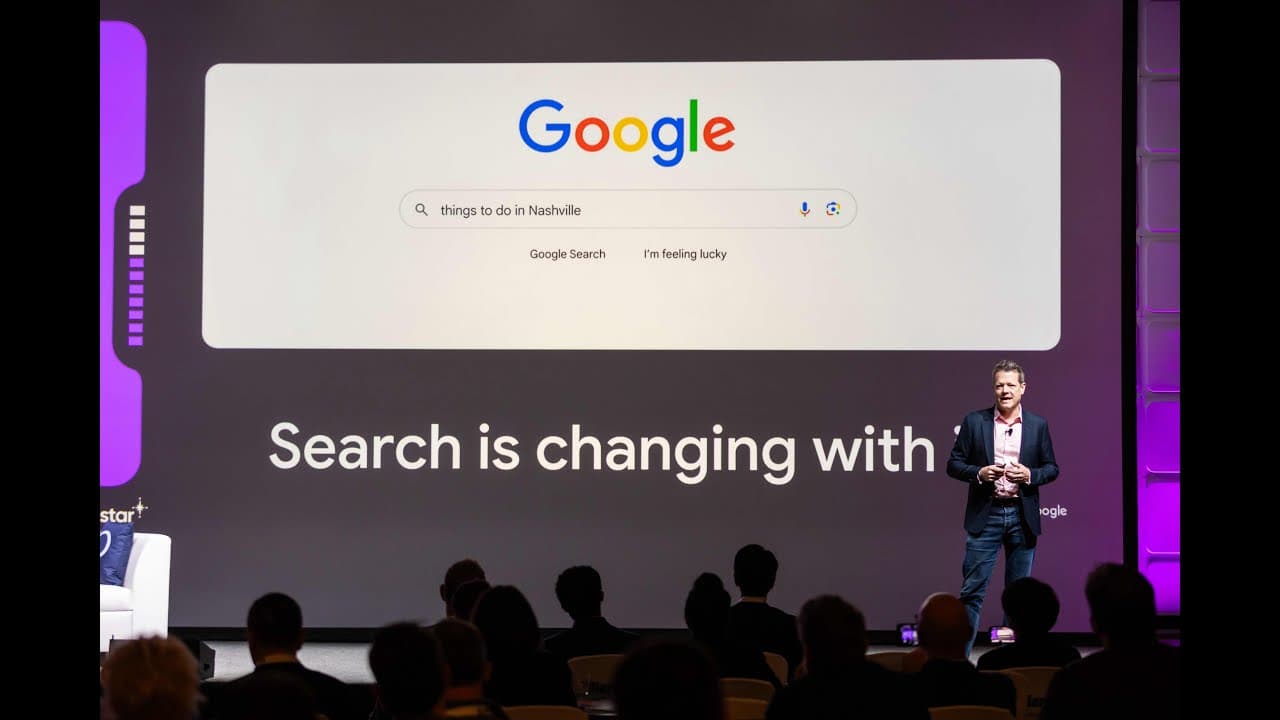
AI, Innovation and the Next Era of Distribution - with Amadeus at The #Phocuswright Conference
Summary
In this fireside chat at The Phocuswright Conference, Robert Buckman, SVP of Solution Consulting Americas at Amadeus, speaks with moderator Pete Comeau about the future of travel distribution, the role of agentic AI, and what will separate industry leaders from laggards. The conversation begins with reflections on the day's startup pitches, where Buckman observes that the diversity of AI use cases—ranging from emotional intent detection to fraud prevention to group travel booking—signals how rapidly agentic AI has permeated the industry since it only became mainstream a short time ago.
Buckman argues that the travel industry is at a genuine inflection point driven by two forces: agentic AI and long-overdue legacy technology replacement. He notes that most of the underlying tech running airlines and hotels has been in place for over 30 years, and that operators now recognize this infrastructure cannot support the personalization levels they aspire to achieve. He points to massive investments underway in offer and order transformation as foundational building blocks for true personalization—work that is largely invisible at conferences dominated by distribution and travel-seller audiences.
On whether the industry is finally ready to deliver an Amazon-like personalized travel experience, Buckman is optimistic but measured. He emphasizes that collaboration—not any single company's technology—is the prerequisite. Amadeus, despite operating mission-critical systems across travel sellers, airline IT, airport IT, and hospitality IT, acknowledges it cannot complete the seamless journey alone. He stresses the need for industry-wide interoperability standards and governance models around data and privacy, and highlights that Amadeus has aligned with Anthropic on Model Context Protocol (MCP) standards, describing it as a deliberate signal that Amadeus is not walling off its ecosystem.
Buckman singles out travel disruption management as the next major frontier likely to be meaningfully solved—potentially within a few years—pointing to Acai Travel (a minority Amadeus investment) as an example of agentic AI's transformative potential in this space. He shares a live internal pilot at Amadeus where an MCP-based voice agent successfully changed a travel reservation in natural language, switching seamlessly between English and French mid-conversation—illustrating how agentic-to-agent interfaces could transform traveler assistance. He also recounts a personal anecdote of witnessing a non-English-speaking Ethiopian Airlines passenger in distress at Newark airport, unable to navigate connections, as a vivid illustration of unmet need that AI-powered multilingual travel agents could address immediately.
When asked what will separate leaders from laggards, Buckman cites bold adoption, willingness to take risk, and a strong commitment to invest. He identifies the underestimated weight of legacy technology in existing tech stacks as the most overlooked distribution challenge. He also dismisses the metaverse as an overhyped AI-adjacent use case for travel, arguing that nothing will replace the intrinsic human value of physically traveling and meeting people. He describes the hospitality IT sector as the space most in need of a full tech reboot—one Amadeus is actively pursuing.
Key Takeaways
- •The travel industry's 30+ year legacy tech stack is the primary constraint on achieving genuine personalization—replacing it with modern offer and order systems is a prerequisite, not an optional upgrade.
- •Agentic AI has spread across travel use cases with remarkable speed; its pervasiveness among startup pitches signals that the innovation curve is steepening, not plateauing.
- •Travel disruption management is the area most likely to see transformative agentic AI breakthroughs in the near term, with voice-based multilingual agents able to guide stranded passengers in real time.
- •Amadeus has aligned with Anthropic on MCP standards as a deliberate commitment to open interoperability—travel technology players should adopt open standards rather than walled-garden approaches.
- •No single company, including a platform player like Amadeus, can deliver a seamless travel experience alone; collaboration across suppliers, sellers, and technology companies is the only viable path.
- •MCP-based agentic-to-agent interfaces are already being piloted internally at Amadeus, demonstrating reservation changes via voice with mid-conversation language switching between English and French.
- •Leaders will be defined by bold adoption and willingness to fail; a conservative, laggard approach to innovation will widen the competitive gap rapidly in an agentic AI environment.
- •The biggest underestimated challenge in distribution is the inertia of legacy systems embedded across the entire travel ecosystem—it cannot be changed overnight.
- •Data access and data-driven decision-making are the true differentiators for personalization; those with the right data are best positioned to deliver on traveler expectations.
- •The metaverse for travel is overhyped and going nowhere—physical travel fulfills a core human need that VR cannot replicate.
Transcript
Welcome. Great to see you. >> Yeah, good to see you. Great. >> So, we saw nine startups pitch today. So, as I think we both expected, we saw quite a bit of AI. We saw corporate travel, events, personalization, fraud, event tech, connectivity. What what's what stood out to you? you know, maybe not doesn't have to be a specific company, but from a from a innovation perspective, what what stood out stood out to you? >> Yeah, I think maybe one of my first observations is just as you kind of highligh...