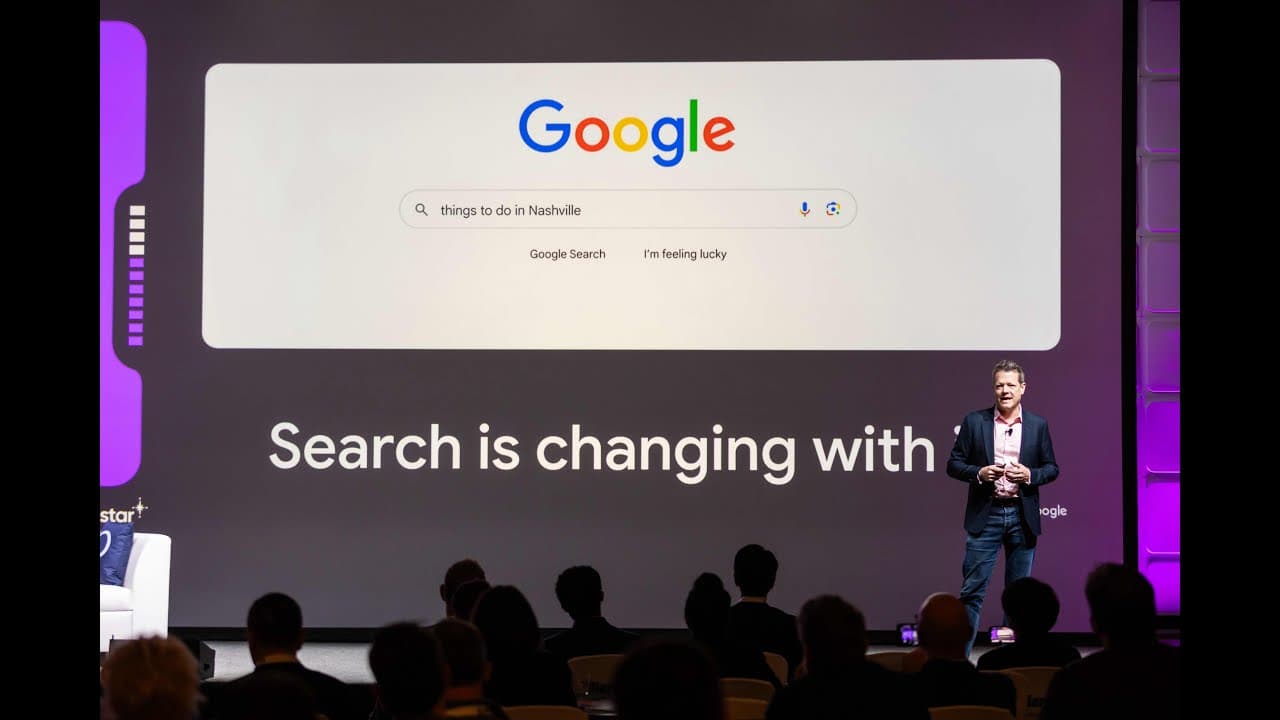
Reinventing hotel booking with AI - Holden, Kaufer and Vakil with Chris Hemmeter - #Phocuswright
Summary
This Phocuswright panel brings together three heavy-hitting travel industry veterans — Richard Holden (former VP/GM of Google Travel), Stephen Kaufer (founder and former 20-year CEO of TripAdvisor), and Sanjay Vakil (CEO and co-founder of DirectBooker, and former product leader at both Google and TripAdvisor) — moderated by Chris Hemmeter of Thayer Investment Partners. The session explores whether the rise of generative and agentic AI fundamentally reshapes hotel distribution power dynamics.
Kaufer frames the current AI moment as the fourth major disruption in travel's digital history, following the OTA revolution, user-generated content, and the Airbnb/VRBO inventory expansion. He draws a sharp distinction between superficial AI use — like generating a Paris itinerary — and genuinely transformational AI that can deliver on the long-promised but never-delivered personalization that major platforms including TripAdvisor failed to achieve. He argues that this time the technology is real, and consumers will be able to have rich, conversational travel planning interactions that actually produce excellent results.
Holden echoes this sentiment, noting that while the data landscape has given consumers access to everything, it has paradoxically burdened them with too much labor. He asserts that AI creates an opportunity for new "front doors" in travel discovery, potentially rebalancing power away from OTAs and back toward suppliers who have always held richer, more detailed information about their properties. He notes that Google's team found consumers significantly more trusting and engaged when supplier-direct content was mixed alongside OTA content.
Vakil explains DirectBooker's thesis and business model: a low-cost API pipe connecting hotel chains directly to AI discovery platforms (like ChatGPT and Gemini), bypassing OTAs. He reports that DirectBooker has signed contracts with six of the top ten hotel chains globally, each of which has expressed enthusiasm for finally having a channel to distribute their deep marketing content — granular property details like hot tub temperatures, pet weight limits, and member-only rates — content that OTAs never captured and that AI engines now hunger for. The model is priced at a fraction of OTA commission rates, below credit card processing fees, while ensuring hotels retain merchant-of-record status, guest email/phone data, and loyalty point crediting — meeting the definition of a "direct booking."
The panelists debate whether the OTA duopoly (Booking Holdings and Expedia, with a combined ~$200B market cap and ~$15B in annual marketing spend) can be dislodged. Kaufer argues it is not a zero-sum game — Booking.com has in fact grown even as hotel chains increased their share of direct bookings — and that DirectBooker plays an additive role rather than launching a frontal attack. The panel closes with unanimous skepticism of an "AI bubble" framing, agreeing that while valuations are frothy, there is genuine, durable value being created in ways that were not possible even two to three years ago.
Key Takeaways
- •Suppliers hold a structural content advantage over OTAs in the AI era — granular property details (pet policies, amenity specifics, member rates) that OTAs never captured are exactly what AI engines need to give better answers.
- •DirectBooker is signing contracts with six of the top ten hotel chains by offering a sub-OTA-commission pipe that qualifies as a true direct booking: hotel is merchant of record, captures guest contact data, and awards loyalty points.
- •The shift from multi-tab browsing (40+ website visits pre-booking) to single conversational AI flows fundamentally changes where and how supply must show up to win.
- •Google's own data showed consumers trusted and engaged more when supplier-direct content was mixed with OTA content — a signal that balance benefits all parties.
- •The AI disruption is not necessarily zero-sum for OTAs; Booking.com has grown alongside rising direct booking share, suggesting the market is expanding rather than simply redistributing.
- •Hotel chains have large volumes of unused marketing content they are eager to distribute but have no good channel for — AI-native pipes like DirectBooker solve a real supply-side problem.
- •LLM platforms (OpenAI, Google) will almost certainly introduce ad units and monetize travel intent, meaning hotels should establish API relationships now before those economics are set.
- •Promising AI travel experiences still have poor UX for actual planning — the opportunity lies in startups building travel-specific interfaces on top of foundational LLMs, not in the LLMs themselves.
- •The panel consensus: AI's current progress represents genuinely transformative and durable value creation, distinct from prior hype cycles like blockchain in travel, even if some startup valuations are inflated.
- For DirectBooker's thesis to succeed, hotels must actively participate and share data; the industry has a history of fumbling technology opportunities that require collective action.
Transcript
All right. Thanks everybody. Thanks for sticking around so late. I appreciate it. We've got 22 minutes and 30 I don't know how we're going to do this. We're going to try hard though. So, this is a very exciting uh panel for me. Um these are three real iconic players from the travel business. I'm going to just give you a quick overview. You know, Richard, 20 plus years at Google, vice president, general manager of Google's travel products. uh basically built Google flights, Google hotels, long fa...