Listening matters: Dialogues as a Key to Sustainable Development
Summary
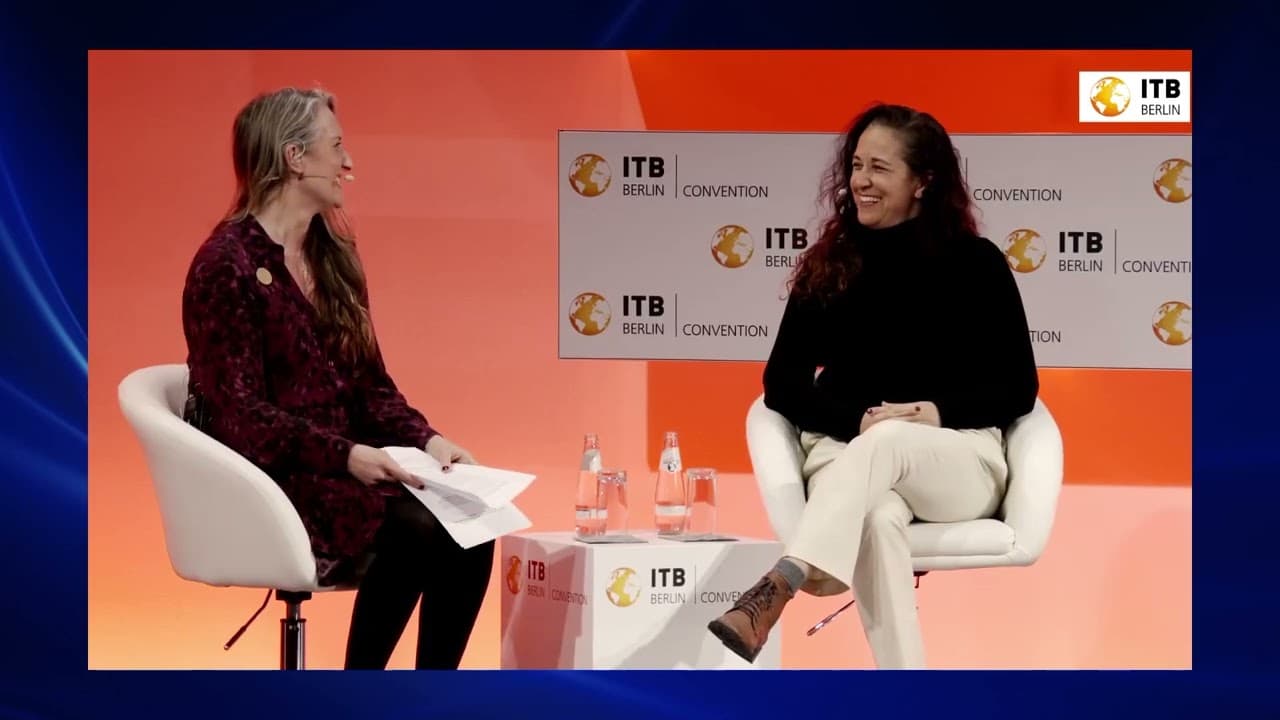
This is a panel session from the ITB Berlin 2026 convention titled 'Listening Matters: Dialogues as a Key to Sustainable Development,' presented as the Studiosus Talk 2026 in its 39th edition, coinciding with ITB's 60th anniversary. The session, moderated by Katie Gallus (journalist and geographer), brought together four panelists: Prof. Dr. Bernhard Pörksen (media scholar, University of Tübingen), Tony Reyhanloo (Head of Corporate Responsibility, Studiosus Group, with 8 years of experience in sustainable value chain stakeholder engagement across 14 countries), Divya Khandal (Managing Director, Dhonk Crafts and Tiger Learning Centre, Ranthambore National Park, India), and Arbana Lleshi (Office Manager, Albtours D / Vas Group, Albania).
Prof. Pörksen opened with a conceptual framework distinguishing two types of listening: the 'I ear,' filtered by personal ideology and prior beliefs, and the 'U ear,' which requires stepping outside one's egocentric perspective to genuinely engage with another's worldview. He warned that smartphones on the table empirically suppress discussion of existential topics. He also cited clear evidence that the higher a person sits in a corporate hierarchy, the less they listen — the more their mouth is open. He described the ideal stakeholder dialogue as a 'dance' where leadership shifts between participants, and introduced the concept of the 'trusted messenger' from communication studies — the idea that what is said matters less than who says it to a given community.
Tony Reyhanloo presented two major case studies. The first involved Studiosus's engagement with Maasai communities in the Serengeti, Tanzania, where customer and staff concerns arose about the authenticity of 'Boma' village visits. Rather than imposing external definitions of authenticity, Studiosus visited multiple Maasai villages to listen to what the communities themselves wanted from tourism — including dos and don'ts for visitors — and co-created a code of conduct. A key insight was that Boma visits represent a major or sole source of income for many Maasai families. The second case study was a water scarcity project in Jordan, where Studiosus convened 25 partner hotels in a workshop. One hotel reported that bathroom water-saving stickers reduced their water consumption by 25%. This measure was adopted across all 25 hotels and integrated into a nationwide water campaign for Jordan.
Divya Khandal described the 17-year Dhonk Crafts program at Ranthambore, which has trained more than 600 families from the Mogiya tribe — historically tiger hunters and later poachers during a period when Ranthambore lost approximately 80% of its tiger population due to demand for tiger parts. The sister organization Tiger Watch, working with Rajasthan police, arrested more than 250 poachers from the tribe. The turning point came when families said their livelihoods had been taken. Alternative livelihood, education, and healthcare programs were introduced. The current flagship initiative, 'Vanya Sakhi' (Friend of the Forest), trains young women and girls relocated from the national park in new skills, connecting them to tiger conservation through tourism. Tony Reyhanloo's visit to Ranthambore initiated a partnership to create 'rules of the jungle' — traveler guidelines for meaningful, conservation-minded forest experiences.
Arbana Lleshi described Albtours D's 33-year operating history in the Balkans as founded on proactive listening across multi-country, multi-culture tour operations spanning Albania, Kosovo, Macedonia, and Montenegro. She detailed a workshop co-facilitated with Studiosus where staff discussed sustainability and discovered the concept extended well beyond climate — prompting the company to pursue broader certification. She also described a sensitive child protection dialogue initiated with Studiosus, emphasizing that the credibility of who brings a sensitive topic to the table determines whether stakeholders engage. On geopolitics, Prof. Pörksen was candid: he is 'quite pessimistic,' citing Donald Trump as 'a mixture between a reality TV star and an internet troll and now an imperialist' who has 'changed the communication climate tremendously by just introducing violence to the table.' Despite this, he maintains hope rooted in the human need for acceptance, arguing that 'the existential need is so strong that listening cannot be erased.'
Key Takeaways
- •Prof. Pörksen presented a two-type listening framework: the 'I ear' filters information through personal ideology and existing beliefs, while the 'U ear' requires asking 'In what world is this relevant, real, true, and beautiful for the other?' He described the shift from I-ear to U-ear listening as the core of genuine dialogue, and emphasized that Zen Buddhism's 'beginner's mind' — approaching situations without hierarchical expert positioning — is a practical method for achieving it.
- •Empirical communication research shows that placing a smartphone on a table suppresses discussion of existential and high-stakes topics. Prof. Pörksen stated there is 'clear empirical evidence' for this, making device-free settings a prerequisite for meaningful stakeholder dialogue in sustainable tourism contexts.
- •Tony Reyhanloo's Studiosus Jordan water scarcity project convened 25 hotels in a workshop setting. One hotel reported that bathroom water-saving stickers reduced consumption by 25%. The measure was immediately adopted across all 25 hotels and built into a broader nationwide Jordanian water campaign — demonstrating how peer-to-peer knowledge sharing within a facilitated listening format can drive scalable, low-cost sustainability outcomes.
- •In the Maasai Boma case (Serengeti, Tanzania, 2025), Studiosus responded to customer and staff concerns about staged authenticity by visiting multiple communities and listening to what Maasai themselves wanted from tourism. The resulting code of conduct was grounded entirely in the communities' own definitions. Reyhanloo stated: 'Who are we from the outside to define what's best for the Maasai? The Maasai themselves are the only ones who can tell us what it means to be a Maasai in 2026.'
- •Divya Khandal's Dhonk Crafts program in Ranthambore has operated for 17 years and trained more than 600 families from the Mogiya tribe, whose members were historically royal hunters and later became poachers when the 1972 Wildlife Protection Act removed their livelihood. Ranthambore lost approximately 80% of its tigers during the late 1990s and early 2000s. Tiger Watch and Rajasthan police arrested more than 250 poachers from the tribe — after which community members came forward asking how to survive, catalyzing the dialogue that built the alternative livelihood program.
Transcript
Lovely to seeing you back here at ITV Berlin Convention 2026. Ladies and gentlemen, it's great to see you here in Berlin, of course, and it's great to see you virtually joining us as well for our next panel. So, our next panel is a highlight on the program of course and it is the studio, the studio talk 2026 in its 39th edition. almost we're almost getting the 40 done. Um, but it is very special as of course we also celebrating this year's ITV 60th anniversary. So, it's really a highlight and it...