Regenerative by design – Stories from Practitioners
Summary
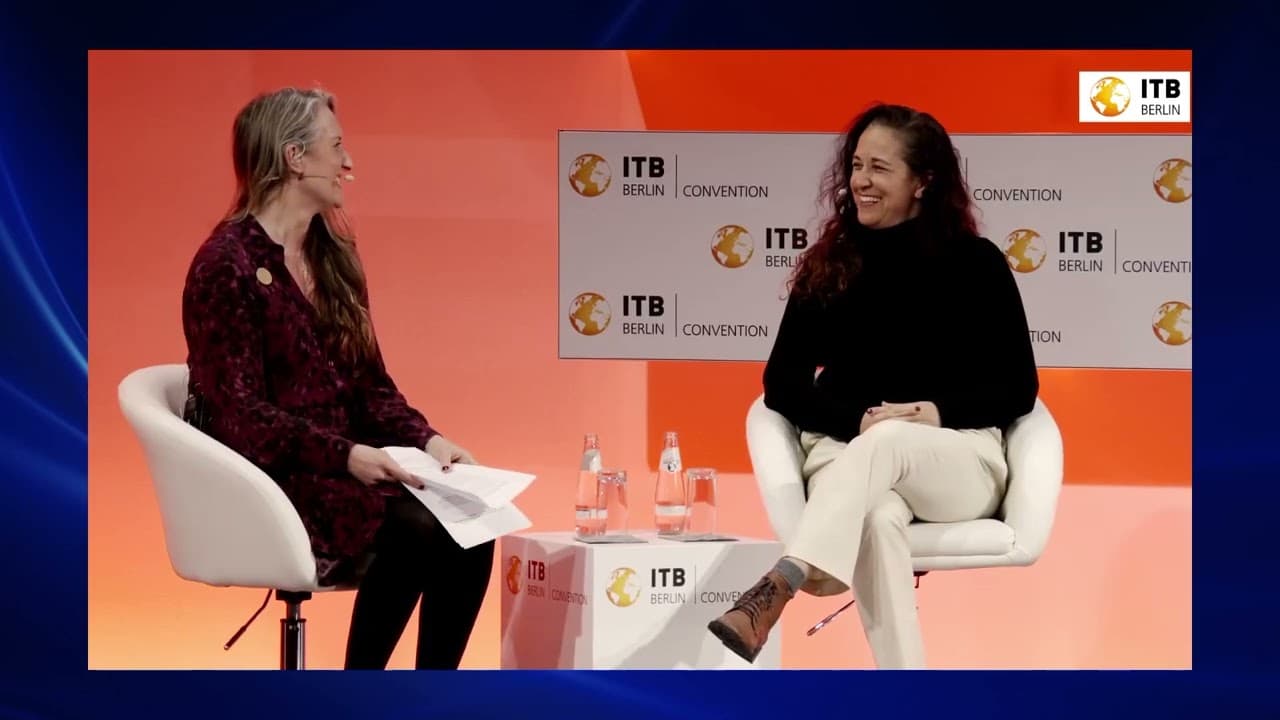
This panel session at ITB Berlin titled 'Regenerative by Design – Stories from Practitioners' brought together three practitioners to explore what regenerative tourism looks like in practice. The session was moderated by Prof. Dr. Willy Legrand of IU International University of Applied Sciences, with panelists Ásta Kristín Sigurjónsdóttir (CEO, Iceland Tourism Cluster), Elke Dens (Founder, Place Generation), and Rob Holmes (Founder & Chief Strategist, GLP Films). The session ran approximately 45 minutes and was structured around short films, audience polling, and a moderated discussion.
Ásta Sigurjónsdóttir opened by challenging the audience's assumptions about growth, invoking a framework drawn from agriculture: regenerative development is 50% mindset, 40% design, and only 10% practice. She argued that the tourism industry risks scaling the 10% — labels, AI pilots, certification schemes, innovation projects — without first building the mindset and design capacity needed to make those practices meaningful. She positioned tourism as a complex adaptive system rather than a machine, drawing a metaphor to the human body: 'You don't fix exhaustion by demanding more output of yourself.' The Iceland Tourism Cluster, which she leads, models tourism as an ecosystem connected by finance, energy, food systems, municipalities, infrastructure, culture, health, and education. An audience Slido poll during the talk showed that 'partnership and networks' was ranked the top driver of business success, followed by 'health of the destination ecosystem.' A second poll on where regenerative change should start found 'mindset' winning by a large margin, followed by 'community relationships' and 'governance/business models.' Asta concluded that the next decade will belong not to the fastest-growing destinations, but to those that 'read and design intelligently.'
Elke Dens of Place Generation presented case studies from three geographies. In the Salish Sea corridor between Vancouver Island and the northern US, commissioned by Destination Canada, her team identified six indigenous First Nations communities straddling the border with family ties across nations — a detail she noted predated any political border. They reframed the corridor not as two nations but as a single bio-region sharing the same ecology, watershed, and wildlife. The project proposed green and blue economy investments including electrified ferries, and introduced bio-regional funding models where investors receive returns only after 25 years — reflecting the long timescale of genuine place transformation. In Helsinki, Place Generation mapped the city's identity down to four core attributes, including one — social equality and inclusive design — that visitors noticed but residents had taken for granted. In Hawaii, Place Generation has been embedded for four years and is now developing a five-year strategy in partnership with Better Destinations. They conducted a published governance study focused on shifting the Hawaiian Tourism Authority from a top-down flow management model to a bottom-up community-led approach, particularly in the wake of the Maui wildfires. Dens emphasized that regenerative work must address dominant mass tourism, not just boutique malama (land stewardship) experiences: 'We cannot only design the new things; we also need to redesign the old things.' Her closing provocation inverted the classic tourism pitch: 'Don't ask what a place can do for you, but ask what you as a tourism professional can do for a place.'
Rob Holmes of GLP Films contributed the storytelling perspective, arguing that transformational content — films, photos, text — is the most scalable mechanism for changing traveler and industry mindsets. He shared the example of spending four days embedded with Bang Hem's community in Bantlay Nak, southern Thailand (a village with a post-tsunami regenerative history), emerging convinced that immersive storytelling is both a conservation tool and an economic one. A second film screened during his segment featured 'The Volcano Lady of Chile,' an example of an outsider who approached a region with intentionality and respect and ultimately achieved community acceptance. Holmes's key argument: travelers and trade partners need to understand both the positive impact and the genuine challenges of tourism — not just the aspirational narrative.
The closing discussion converged on several shared themes: the need to stop treating destinations as products; the importance of indigenous knowledge (particularly in climate adaptation, where Holmes noted that the Haida Nation has 10,000 years of accumulated ecological knowledge that western science is only now catching up to); and the view that the most memorable tourism experiences are the unscripted, unpriced, organic ones — Legrand's personal anecdote of drinking beer with a hotel owner in Eastern Europe and hearing the history of his village exemplified this.
Key Takeaways
- •Regenerative development follows a 50/40/10 rule borrowed from agriculture: 50% mindset, 40% design, and only 10% practice. Ásta Sigurjónsdóttir warned that the industry is dangerously scaling the 10% — 'labels, AI pilots, innovation projects, certification schemes' — without building the foundational mindset and design capacity, which she called 'the real risk.'
- •Tourism is not a complicated system; it is a complex adaptive system. Sigurjónsdóttir drew on systems theory and a quote from regenerative design thinker Diane Dretz: 'Living systems don't respond to control — they respond to conditions.' Treating destinations like machines rather than ecosystems produces fragile systems that cannot adapt.
- •The Iceland Tourism Cluster reframes the core business question from 'How does my business grow?' to 'How does the ecosystem I depend on stay healthy?' The cluster map connects tourism businesses with finance, energy, food systems, municipalities, infrastructure, culture, health, and education — modeling the destination as a living system rather than an industry sector.
- •An ITB Berlin audience poll (via Slido) found that 'partnership and networks' was the top driver of business success, followed by 'health of the destination ecosystem' — ahead of market demand and internal strategy. A separate poll on where regenerative change should start found 'mindset' winning by a wide margin, ahead of community relationships and governance/business model reform.
- •Elke Dens of Place Generation declared: 'Generic is the kiss of death. Generic is the opposite of regenerative.' She argued that destinations, by trying to differentiate, have paradoxically converged into a 'sea of sameness' — following the same trends, chasing the same travelers, and eroding their own uniqueness.
- •In the Salish Sea corridor (between Vancouver Island and the northern US), Place Generation — commissioned by Destination Canada — reframed the region not as a US-Canada border zone but as a single bio-region shared by six indigenous First Nations communities. The project proposed bio-regional funding models where investors only receive returns after 25 years, reflecting the true timescale of place transformation.
Transcript
And so this panel uh basically asks or demands you know what does regeneration demand. Now comes the harder part. What does it actually looks like in practice? So we've heard actually about the practice from David just now. But the answer is not a best practice. You can copy paste necessarily as we've heard. It looks different every time. Every different destination, every place, every specific communities. And so we're going to hear from three different lenses of the same challenge. And we'll s...