What If the Impossible Is Just the Next Thing We Haven't Tried Yet?
Summary
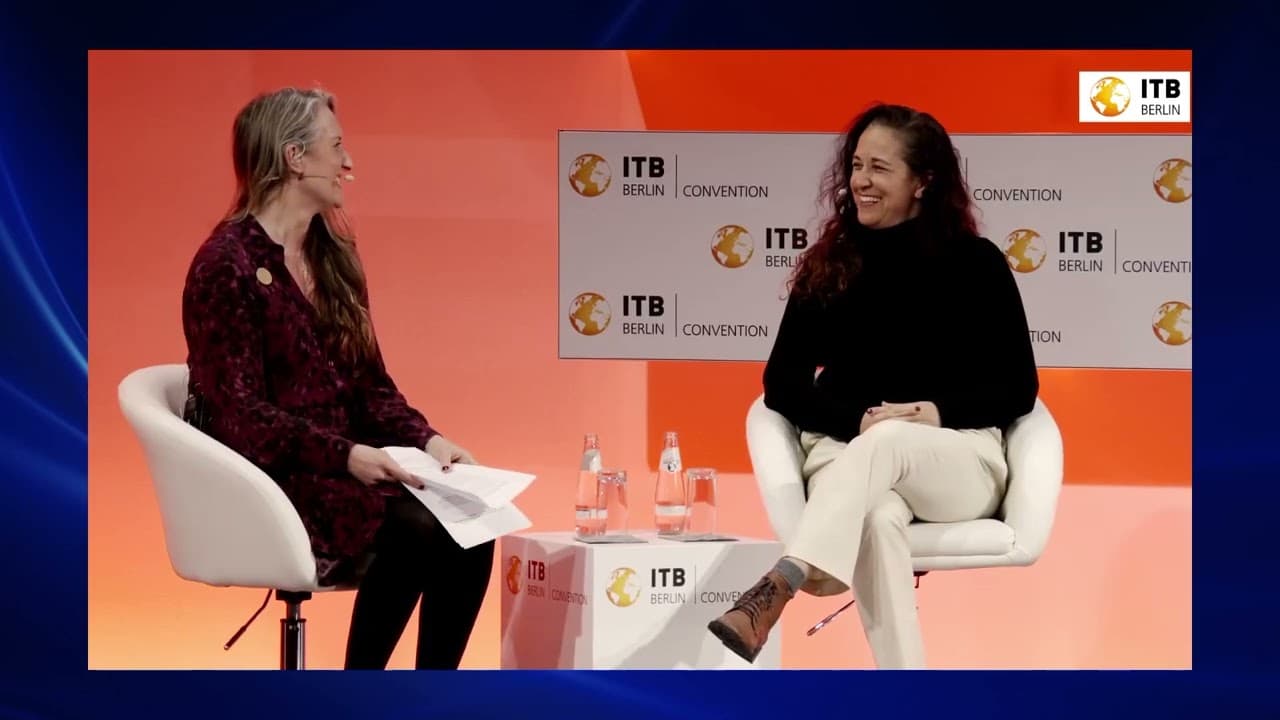
This closing session of the ITB Berlin 2026 responsible tourism track presented three concrete proof-of-concept stories under the framing 'What if the impossible is just the next thing we haven't tried yet?' Hosted by journalist-geographer Katie Gallus and moderated by Prof. Dr. Willy Legrand of IU International University of Applied Sciences, the 31-minute session was structured as rapid-fire evidence presentations — no panel debate, just three seven-minute stories of transformative action.
The first proof point came from Ellen Madeker, Head of Public Policy DACH & CEE at Airbnb, who described an unlikely €1.5 million partnership with the German heritage association Schlösser und Gärten (Castles and Gardens). Airbnb — a young American tech company in sneakers — partnered with a formal, suit-and-tie German national heritage preservation organisation to restore rural cultural monuments. A jury of 13 experts evaluated applications against high standards; 26 projects were ultimately funded across three years. Case examples included a historic mill in southern Germany whose owners learned of the grant through an Airbnb guest staying there, a baroque manor house in northern Germany that had fallen into disrepair after WWII and was restored to win a federal preservation award, and a castle with a direct royal connection — it was the childhood home of Princess Margarita of Hohenlohe-Langenburg, sister of Prince Philip. All 26 restored sites are now bookable on Airbnb. The core insight: tourism can protect heritage rather than merely consume it.
The second proof point came from Tom Armitt, Senior Manager for Climate and Biodiversity at Planeterra, sharing the story of Beh — a community enterprise in Chatile, in Mexico's Yucatan Peninsula. A group of young men led by Ivan returned to the cenotes (ancient sinkholes, sacred to the Maya, forming the world's largest underground freshwater table) to find them used as dumping grounds. Without a grant, a petition, or an NGO, they bought gloves and bin bags and spent an entire summer hauling hundreds of kilos of waste from cenote to cenote. The community responded by volunteering. Ivan spoke at local schools. They then built a bike tour, partnered with indigenous elders to incorporate Mayan ceremony, wove local restaurants into itineraries, built non-invasive infrastructure, purchased a minibus, and grew to a team of 23 people — each having made a personal vow to protect the cenotes. Ivan's quote: 'We are doing this with the heart. The cenotes have given us so much health, well-being, love for nature. We owe it to the cenotes to continue this work so that future generations have the same opportunities that we did.' Their next ambition: legally protect a community-managed area around Chatile against encroaching real estate development. Beh is one of 550 community enterprises Planeterra works with across 83 countries.
The third proof point came from Natalia Rosa, Tourism Consultant for KAZA (Kavango Zambezi Transfrontier Conservation Area). KAZA is a 520,000 square kilometre shared landscape — larger than Germany and Austria combined — spanning five sovereign nations: Angola, Botswana, Namibia, Zimbabwe, and Zambia, governed by a treaty signed in August 2011 in Luanda. The area holds 228,000 elephants (over half of Africa's entire savannah elephant population), 197 mammal species, 650+ bird species, 3,000+ plant species, and three UNESCO World Heritage sites including Victoria Falls. The challenge was never conservation per se — all five governments agreed on the need — but coordination across five separate legal frameworks, visa regimes, wildlife authorities, and tourism policies. The treaty enabled ecosystem logic to override boundary logic. A practical example: Angolan elephants driven out by civil war are returning through the Cuando wildlife corridor — not through a translocation programme, but because four governments maintained an unfenced passage and elephants remembered their ancestral routes. The closed-loop value chain: conservation enables corridors, corridors enable wildlife, wildlife enables tourism, tourism revenue (via community-owned lodges like Kasali La Pala) funds conservation. The Chobe River tourist experience crosses Botswana and Namibia on a single boat journey — clearing immigration at a jetty, viewing elephants on both banks simultaneously. The session closed with Legrand identifying 'AI cannot save nature but can be a tool used wisely' and food/agriculture, architecture/urban design, and bio-regionalism as topics for ITB 2027.
Key Takeaways
- •Airbnb donated €1.5 million to Schlösser und Gärten (Germany's national castles and gardens heritage association), funding 26 projects selected by a 13-expert jury over three years — all 26 heritage sites are now bookable on Airbnb, turning conservation into a live hospitality product.
- •The Airbnb-heritage partnership was explicitly described as 'almost impossible' given the cultural mismatch: an English-speaking American tech company in sneakers versus a formal German preservation institution in suits — underscoring that the most productive partnerships are often the least obvious ones.
- •Beh's origin story: Ivan and his friends in Chatile, Yucatan, purchased gloves and bin bags with their own money and hauled hundreds of kilos of waste from sacred cenotes over an entire summer — no grant, no NGO, no petition — before building what became a 23-person community enterprise.
- •Ivan's operational integrity quote: 'We don't want to lose our mind for money. We want to stay faithful to the essence of our relationship with the cenotes.' Tom Armitt described this as 'integrity made operational' — not a consultant's mission statement.
- •Beh's next strategic move is legal protection of a community-managed area around Chatile against encroaching real estate development, signalling a progression from conservation to conservation-backed land policy advocacy.
- •Planeterra works with 550 community enterprises across 83 countries — Beh is one data point in a global proof set of the same regenerative model compounding.
- •KAZA encompasses 520,000 km² (larger than Germany and Austria combined), 3 million residents, 19 national parks, 5 major rivers, 3 UNESCO World Heritage sites, and 228,000 elephants — over half of Africa's entire savannah elephant population.
- •The August 2011 Luanda treaty was a pivotal geopolitical moment: five heads of state chose 'ecosystem logic over boundary logic,' agreeing that wildlife corridors matter more than administrative lines — enabling Angola's elephants to return home along ancestral routes without any translocation programme.
Transcript
we'd like to do the curve over to uh what's actually impossible or possible within our industry and so uh thank you again for to for visiting uh uh the uh ITB and he's going to be around so in case you want to talk to him afterwards so he showed us a little bit sort of that impossible mindset this was the purpose as well the the trip is amazing there is no doubt about it but if you get a chance to talk to to talk what you will see is is the mindset of taking something we think is impossible and ...