The Understanding: Polycrisis in Travel
Summary
This panel at ITB Berlin 2026 brought together three distinct perspectives — a conflict-resolution entrepreneur, a government minister, and a data analyst — to examine what moderator Katie Gallus framed as the central question: 'How do we lead tourism into balance when balance itself has become such a moving target?' The conversation challenged simple narratives and produced genuinely contrasting viewpoints on tourism's role in a world of overlapping crises.
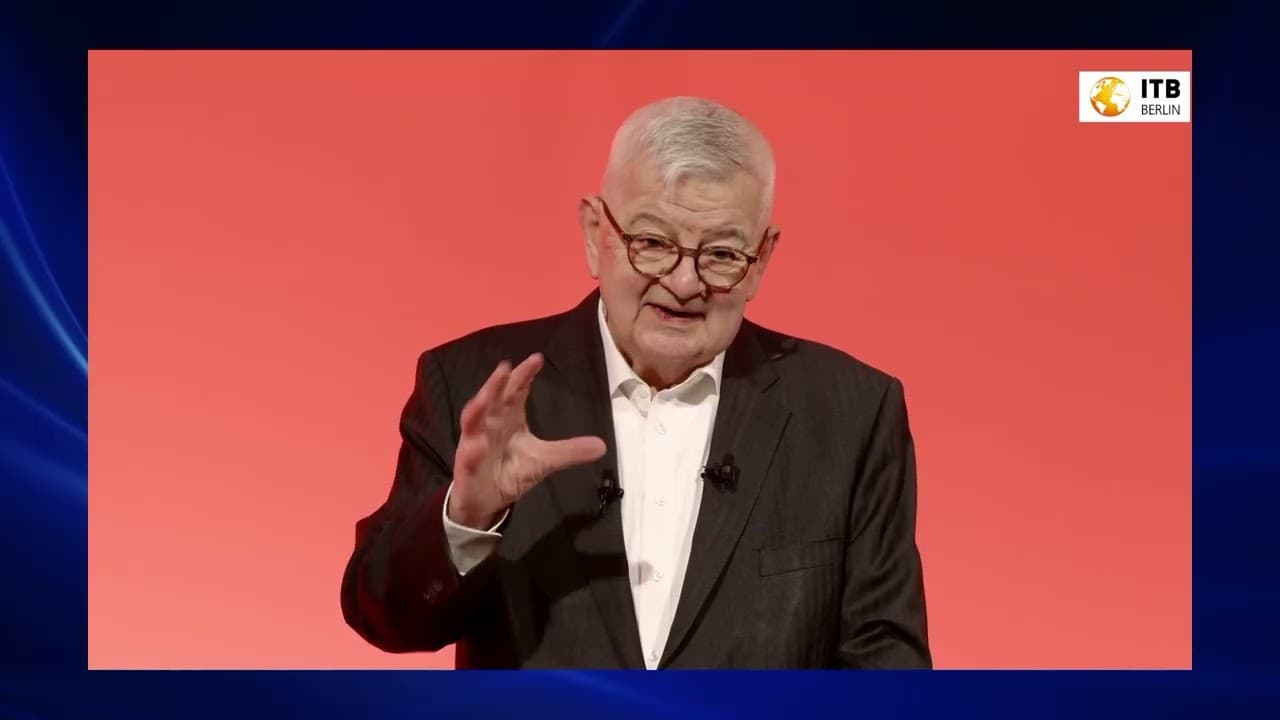
Aziz Abu Sarah, co-founder of Mejdi Tours (operating in 40+ countries), argued that polycrisis is not new — wars, occupations, and conflict existed 30, 40, and 50 years ago — what has changed is the travel industry's willingness to acknowledge and engage with them. Abu Sarah's Mejdi Tours model runs Israeli and Palestinian co-guided trips through conflict zones, deliberately leaning into political and social tensions rather than sanitizing them. He reported that participants who come afraid consistently leave inspired, with transformed perceptions of the region. He cited a recent book he co-authored with a Jewish colleague whose parents were killed on October 7, titled 'The Future Is Peace,' framing travel itself as an act of diplomacy. He challenged a claim made by former German Foreign Minister Joschka Fischer earlier at the conference that 'tourism does not bring peace,' arguing the personal experience of millions of travelers proves otherwise.
Minister Edmund Bartlett (Jamaica's Minister of Tourism, serving his fourth term and co-founder of the Global Tourism Resilience and Crisis Management Centre) provided the geopolitical and crisis management lens. He described Jamaica's experience with Hurricane Melissa — which struck with sustained winds of 190 mph and gusts to 220 mph, a barometric pressure of 891 millibars, lasting eight hours across a third of the country and causing $8–10 billion USD in damage (approximately 30% of GDP), damaging 150,000 physical units and impacting 1.5 million people. Despite that scale, Jamaica lost only 38 lives, restored 90% of energy and water within four weeks, and reopened to international tourists by December 15 — less than seven weeks after the October 28 event. At the time of the hurricane, 25,000 international visitors were on-island; all were safely repatriated within five days. The minister argued this rebuilt confidence and trust in destination Jamaica. He recommended political leaders establish tourism innovation incubators with dedicated funding for young entrepreneurs with ideas but no collateral, citing Jamaica's own program.
Stephen Dutton (Global Insight Manager at Euromonitor International, overseeing research across 84 countries and 16 offices) brought the empirical dimension. He noted that inbound tourism to the US declined in 2025, linking it directly to traveler anxiety about political changes and new border procedures, with Europeans actively delaying trips. He highlighted China as a second case study: slower post-pandemic reopening, domestic economic stress, and 500,000 flights canceled in three days due to conflict with Japan — all reducing outbound Chinese travel. He identified 'soft drivers' — especially uncertainty and friction — as critical but hard-to-quantify variables that mainstream forecasting models miss. He cited the UK's April 2025 introduction of an ETA (Electronic Travel Authorization) as a concrete friction example. His core finding: despite economic pressure, travel spending continues to grow paradoxically, because travel serves as a psychological escape and aspirational outlet during times of anxiety. He recommended every tour operator and destination re-examine their target demographic, noting audiences are likely becoming more regional/local as international flows reshape.
Key Takeaways
- •Polycrisis is not new — Aziz Abu Sarah explicitly argued that wars and occupations existed 30–50 years ago; what changed in the last decade is the industry's willingness to stop ignoring them rather than any objective increase in global instability.
- •Direct debate with Joschka Fischer: Abu Sarah challenged Fischer's earlier on-stage claim that tourism does not bring peace, stating 'I beg to differ' and citing thousands of travelers whose perceptions transformed after Mejdi Tours co-guided conflict-zone experiences.
- •Mejdi Tours model insight: when travelers are taken on Israeli-Palestinian co-guided tours and asked their highlight at the end, almost none cite the pyramids, Al-Aqsa Mosque, Western Wall, or beaches — the near-universal answer is a dinner or personal human connection.
- •Jamaica's Hurricane Melissa response — 25,000 foreign visitors safely repatriated in 5 days post-190mph hurricane; 90% of energy and water restored within 4 weeks; full reopening to tourism by December 15 (28 days after the October 28 strike); $8–10B USD in damage (30% of GDP) with only 38 lives lost.
- •Euromonitor data: US inbound tourism fell in 2025, with a direct causal link to traveler anxiety about political changes and immigration/airport procedures — European travelers explicitly stating they are delaying US trips.
- •China travel disruption: approximately 500,000 flights canceled in three days due to conflict with Japan, illustrating acute polycrisis impact on a major outbound source market that was already slowed by pandemic recovery lag and domestic economic challenges.
- •The UK's ETA introduction in April 2025 is cited as a concrete friction case — Dutton himself nearly missed his trip because he discovered the new requirement at the last minute — illustrating how seemingly minor policy changes create outsized traveler anxiety.
- •Paradox finding from Euromonitor: despite reduced consumer purchasing power and economic pressure across markets, travel spending continues to grow — driven by travel's function as a psychological escape and aspirational high-value expenditure category.
Transcript
Welcome back for the ITV Berlin 2026 edition here of course welcome to all of you of course joining us now for our panel with the title of the understanding of the poli crisis in travel and ladies and gentlemen as you all know we talk a lot about crisis in tourism these days we talk about climate crisis geopolitical crisis the crisis in the Middle East economic crisis workforce and labor a crisis or crisis is really the term of today and the time. Um, and sometimes it sounds that tourism is perm...